Written by Alex Ren
Updated on 15 min read
Study time break ratios: the numbers, the evidence, and why your ratio matters less than you think
Quick summary Short answer: study for 25 to 50 minutes, then break for 5 to 15. Any ratio in that band works, and the only trial that put the popular ones head to head found no significant difference between them on productivity, task completion or flow. The ratio is not where your results are decided, which is the part every other page on this subject leaves out.
In this article
- The study break ratios people actually mean
- Where 52/17 and 50/10 actually come from
- The one trial that compared study break techniques head to head
- What does change how much you remember: spacing, not ratios
- How to pick your study break ratio in one minute
- Setting it up on a Mac, and where the built-in tools stop
- The real failure mode is not the ratio, it is the break you skip
- When this stops being a scheduling problem
- Frequently asked questions
That is the honest version of the answer, and it is worth saying up front because this is a topic where confident numbers outnumber evidence by a wide margin. Search study time break ratios and you will be told, in a firm voice and usually without a single citation, that the answer is 50/10, or 25/5, or 52/17. Below: where each of those numbers actually came from, what happened when researchers finally tested them against each other, the two things that do measurably change how much you retain, and how to set the whole thing up on a Mac so it runs without you.
The study break ratios people actually mean#
Four numbers do almost all the work in this genre. They are not competing theories so much as four different guesses at the same thing, and it is useful to see them next to each other with their provenance attached, because the provenance is the interesting part.
| Ratio | Study | Break | Where the number came from |
|---|---|---|---|
| Pomodoro (25/5) | 25 min | 5 min, then 15 to 30 after four rounds | Francesco Cirillo's kitchen timer, late 1980s. A personal method that worked, not a lab finding. |
| 50/10 | 50 min | 10 min | No identifiable source. The pages that rank for it cite nothing. |
| 52/17 | 52 min | 17 min | DeskTime's 2014 analysis of its own users' computer activity. Observational telemetry, not an experiment. |
| 90-minute blocks | 90 min | 20 to 30 min | An extrapolation from ultradian rhythm research that was about sleep cycles, not about studying. |
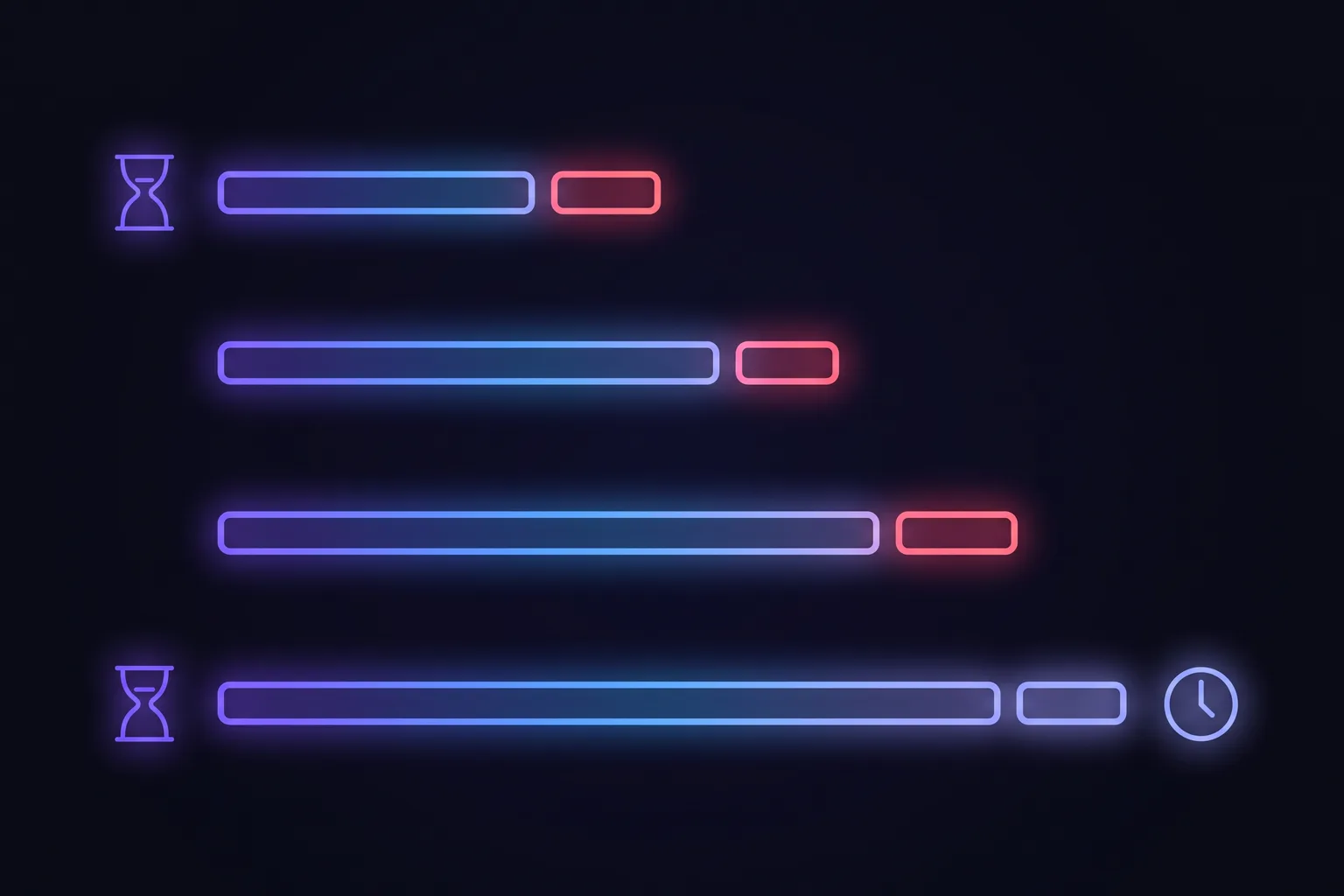
Notice what is missing from that last column: not one of these ratios came out of an experiment designed to find the best study break ratio. Two came from one person's habits, one came from software telemetry, and one is a borrowed idea from sleep science. That does not make them useless. It does mean nobody has earned the right to give you a precise number in a confident voice.
Where 52/17 and 50/10 actually come from#
The 52/17 rule is the one worth understanding in detail, because it is the most cited and the most misdescribed. In 2014, the time-tracking company DeskTime looked at the computer activity of the most productive 10% of its own users and reported that they averaged roughly 52 minutes of work followed by roughly 17 minutes away. That is a real observation about real people. It is also, structurally, a description of what high performers happened to do, not a test of what caused them to perform. Nobody was assigned to a 52/17 condition.
The detail that almost never travels with the rule is what happened next. DeskTime revisited its own data after the pandemic and found the pattern had moved to roughly 112 minutes of work and 26 of break. The same company, the same method, a different number. A constant of human attention does not do that. A snapshot of how a particular population worked in a particular year does exactly that.
The 50/10 rule is simpler to explain: as far as I can tell, it has no origin. The pages that rank for it assert the ratio and move on, without a study, a name or a date. That is not a scandal, 50/10 is a perfectly sensible rhythm, but you should know you are being handed a round number rather than a result. If you want the full comparison of these rhythms for work rather than study, it has its own article here.

The one trial that compared study break techniques head to head#
In 2025, researchers finally ran the comparison the internet had been skipping. Smits, Wenzel and de Bruin, published in Behavioral Sciences, put 94 university students through a two-hour study session under three different break regimes and measured motivation, productivity, fatigue, flow and how much of the task they actually finished.
- Self-regulated: break whenever you want, for as long as you want.
- Pomodoro: 25 minutes of study, 5 minutes of break, four times.
- Flowtime: study until your focus goes, then take a break sized to how long you just worked (5 minutes after 25 or less, 8 minutes after 25 to 50, 10 minutes after more than 50).
The headline result is a null result. There were no significant differences between the three groups on overall motivation, productivity, fatigue, flow or task completion. Completion rates landed at 70.3% for the self-regulated group, 69.4% for Pomodoro and 67.1% for Flowtime, which is close enough to be noise. Flow scores were 4.22, 4.10 and 3.98. The authors' own conclusion is that none of these techniques should be recommended over the others.
The second result is the one that should change how you read every other page on this topic. The two structured techniques did not merely fail to win, they lost ground on the measures that track how a session feels over time. Both the Pomodoro and Flowtime groups showed a significantly steeper decline in motivation across the session than the students who simply broke when they felt like it, and the Pomodoro group's fatigue rose faster as well. Being handed a timer and told when to stop made a two-hour session slightly worse, not better.
So if you came here to find out whether 50/10 beats 25/5, the useful answer is that the question has been tested once and the answer was no. Pick the one you will tolerate. Then spend your attention on the two things below, which is where the effects actually are.
What does change how much you remember: spacing, not ratios#
There is a break that has enormous evidence behind it, and it is not the one inside your study session. It is the break between sessions. Cepeda, Pashler, Vul, Wixted and Rohrer's meta-analysis in Psychological Bulletin pulled together 839 assessments of distributed practice from 317 experiments across 184 articles, and the finding is one of the most reliable in the whole of learning research: the same total study time produces substantially better retention when it is spread across days than when it is packed into one sitting.
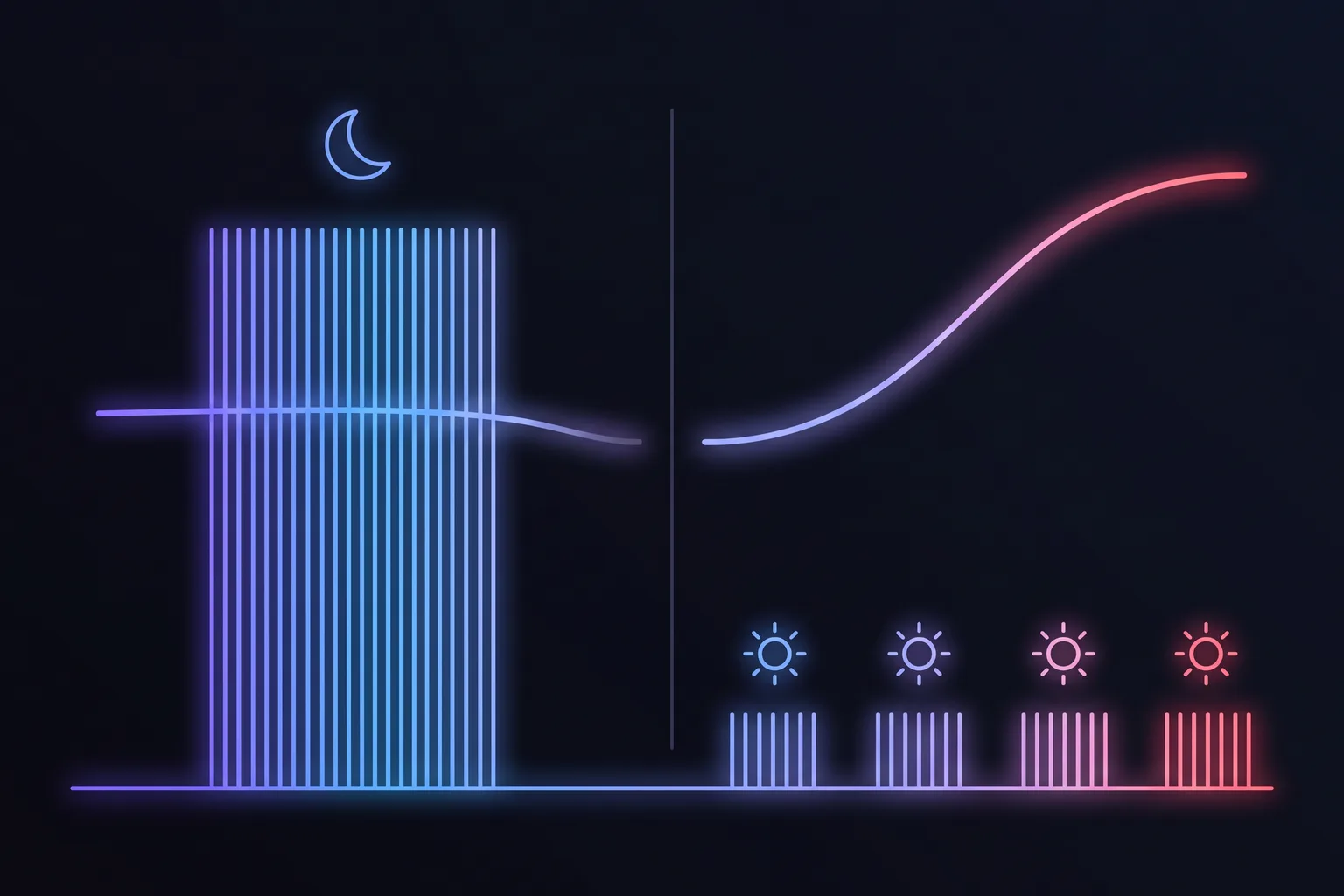
The meta-analysis also gives you a rule for how far apart to space things, which is more actionable than any within-session ratio. The optimal gap between study sessions grows with how long you need to remember the material. Roughly: if the exam is a week away, gaps of about a day work well. If it is a month away, gaps of several days to a week are better. Cramming the night before is not simply tiring, it is the specific pattern this literature shows to be worst for anything you need to still know in two weeks.
Within a session, the evidence that does exist is about how you feel rather than what you retain. A 2022 meta-analysis of micro-breaks covering 22 studies found that short breaks reliably increase vigor and reduce fatigue, with the effect on performance smaller and clearer for less demanding tasks. That is a good reason to take breaks. It is not a reason to believe in any particular number of minutes.
How to pick your study break ratio in one minute#
Given all of the above, here is a defensible way to choose, based on the type of work rather than on a number someone put in a headline.
- Dense, effortful material (proofs, problem sets, a language you are bad at): 25 to 30 minutes on, 5 on. Short blocks because the material is what makes it hard to continue, and a shorter runway makes starting easier.
- Reading, essays, revision passes: 45 to 50 on, 10 off. Long enough to get somewhere before the interruption costs you the thread.
- Deep work you are already absorbed in: let it run, then take a proportionally longer break. Interrupting genuine flow to obey a timer is the mistake the Flowtime condition was designed around, and it is why fixed timers annoy people who were doing fine.
- A long session, three hours or more: whatever your working ratio, add a real 30-minute break every two to three hours. Food, daylight, away from the desk.
- Every ratio, without exception: the break has to leave the screen. Scrolling for 10 minutes is not a break for your attention or your eyes, it is the same activity with worse content.
One more thing that matters more than the split: your eyes do not care about your study schedule, they care about how long they have been locked at one distance. Long sessions are exactly where digital eye strain comes from, and the fix is the 20-20-20 rule running underneath whatever ratio you chose, not instead of it.
Setting it up on a Mac, and where the built-in tools stop#
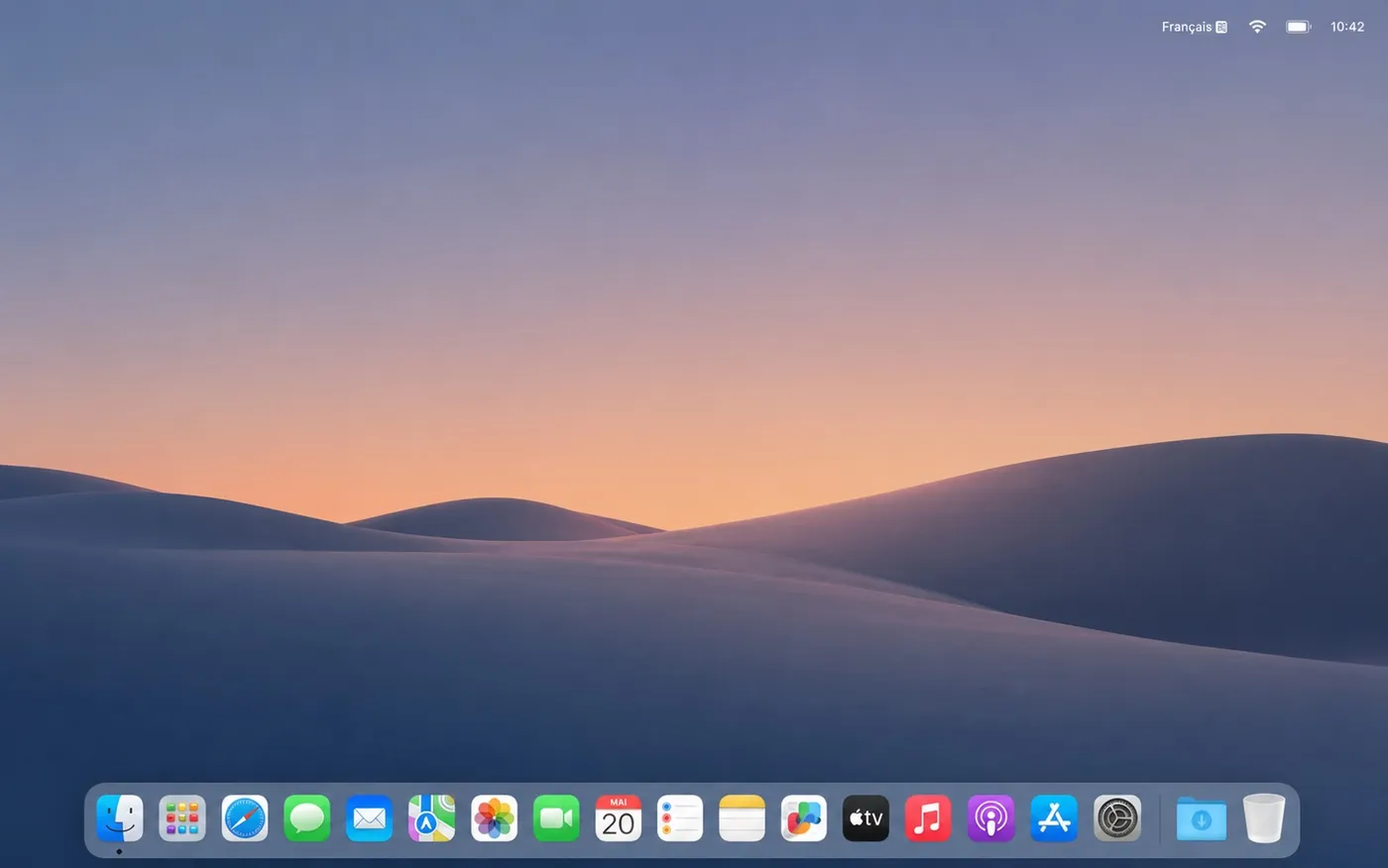
If you study on a MacBook, macOS gives you two thirds of what you need and then leaves the important third out. Worth knowing which is which before you go looking for an app.
- Focus modes (System Settings, then Focus) silence notifications and can turn themselves on to a schedule, so a 7 pm to 10 pm revision Focus is genuinely useful. What a Focus mode does not do is tell you when to stop. It protects the study block and ignores the break entirely.
- Screen Time app limits (System Settings, then Screen Time) are the closest built-in equivalent to a break timer, and their weakness is by design: when a limit fires, the sheet offers Ignore Limit and a one-minute or all-day dismissal. On the evening it matters, you will click it. A limit you can wave away in one click is a suggestion.
- Night Shift and True Tone shift color temperature over the evening. Useful for late sessions and sleep, irrelevant to breaks. Do not let a warmer screen convince you that you have addressed anything about session length.
- The MacBook screen sits below eye level, which is fine for an hour and not for five. For a long revision day, raise the laptop and use a separate keyboard, or expect your neck to bill you for it later.
The gap is the same one the research points at. Every built-in tool on the machine is good at protecting your focus and bad at ending it, because ending it is the part nobody wants at the moment it happens.
The real failure mode is not the ratio, it is the break you skip#
Go back to the trial for a second, because there is a detail in it that deserves more attention than the null result. Every group in that study took breaks. They were in a controlled setting, running a protocol, with researchers measuring them. That is not your Tuesday night.
On a normal evening, the failure is never that you chose 50/10 when 52/17 was marginally better. It is that you sat down at 8, looked up at 11, and took no break at all, because deep work is precisely the state in which you stop noticing time, and because the moment a break is due is the moment you least want it. Knowing the rule and following the rule are different skills, and only one of them has anything to do with picking the right number.
This is why the honest advice at the end of an article about ratios is to stop optimising the ratio. Choose something in the 25-to-50 band, put the enforcement somewhere outside your own willpower, and spend the effort you were about to spend on scheduling on spacing your sessions across more days instead. If you want the tooling side of it, we keep an honest comparison of break apps, including where ours is not the right pick.
When this stops being a scheduling problem#
Break ratios are a productivity question, right up until they are not. A few patterns are not solved by a better timer, and are worth taking to a doctor, a campus health service or a student counselling service rather than to another article like this one.
- You cannot concentrate for even short blocks, across weeks, in every subject, including ones you like. Persistent attention difficulty that predates exam season is worth assessing properly rather than scheduling around.
- Headaches, blurred vision or eye pain that do not clear when you stop studying. Symptoms that track your screen day and fade overnight are ordinary eye strain; symptoms that persist regardless of rest point somewhere else and deserve an eye exam.
- Sleep that has stopped working. Lying awake after study sessions, or waking unrefreshed for weeks, undoes far more retention than any ratio can win back.
- Exhaustion, cynicism about your course and a sense of being ineffective, together and lasting. That triad is the recognised shape of burnout, and it does not respond to a shorter Pomodoro.
- Studying feels impossible rather than hard, or you are relying on stimulants to get through sessions. Both are worth saying out loud to someone qualified.
None of that is an emergency in most cases, and none of it is a character failure. It is just the point where the useful question stops being how many minutes and starts being what is going on.
Frequently asked questions
How long should I study before taking a break?
What is the best study break ratio?
Is the 50/10 rule good for studying?
How long should study breaks be?
Should I study for 2 hours straight without a break?
Is the Pomodoro technique good for studying?
Does spacing my study sessions matter more than the break ratio?
Sources & further reading
- Smits, Wenzel & de Bruin, Investigating the effectiveness of self-regulated, Pomodoro, and Flowtime break-taking techniques among students, Behavioral Sciences 15(7):861 (2025)
- Cepeda, Pashler, Vul, Wixted & Rohrer, Distributed practice in verbal recall tasks: a review and quantitative synthesis, Psychological Bulletin 132(3):354-380 (2006)
- Albulescu et al., Give me a break! A systematic review and meta-analysis on the efficacy of micro-breaks, PLOS ONE (2022)
- DeskTime, Does the 52-17 rule really hold up? (post-pandemic update)
- American Optometric Association: Computer vision syndrome
- The Pomodoro Technique, official site (Francesco Cirillo)
- American Psychological Association: Give me a break, the research on rest at work