Written by Alex Ren
Updated on 15 min read
Spectacles for myopia: which lenses actually slow it down, and which just make the blur go away
Quick summary Spectacles for myopia do one job reliably: they move the focus back onto your retina, so the distance is sharp again. What ordinary glasses do not do is change where your short-sightedness ends up, and there is exactly one class of lens that does, tested almost entirely in children aged six to thirteen. That gap between correcting and controlling is the whole subject, and it is the part the shopping pages skip.
In this article
- What myopia glasses actually do, and what they cannot do
- Myopia control lenses: the spectacles that change the trajectory
- Spectacles for myopia in adults: the part the shopping pages leave out
- Eye care for myopia: what actually helps, by age
- Do blue light glasses help with myopia?
- Reading your prescription: what -2.00 actually means
- When myopia needs a doctor rather than a new pair of glasses
- Frequently asked questions
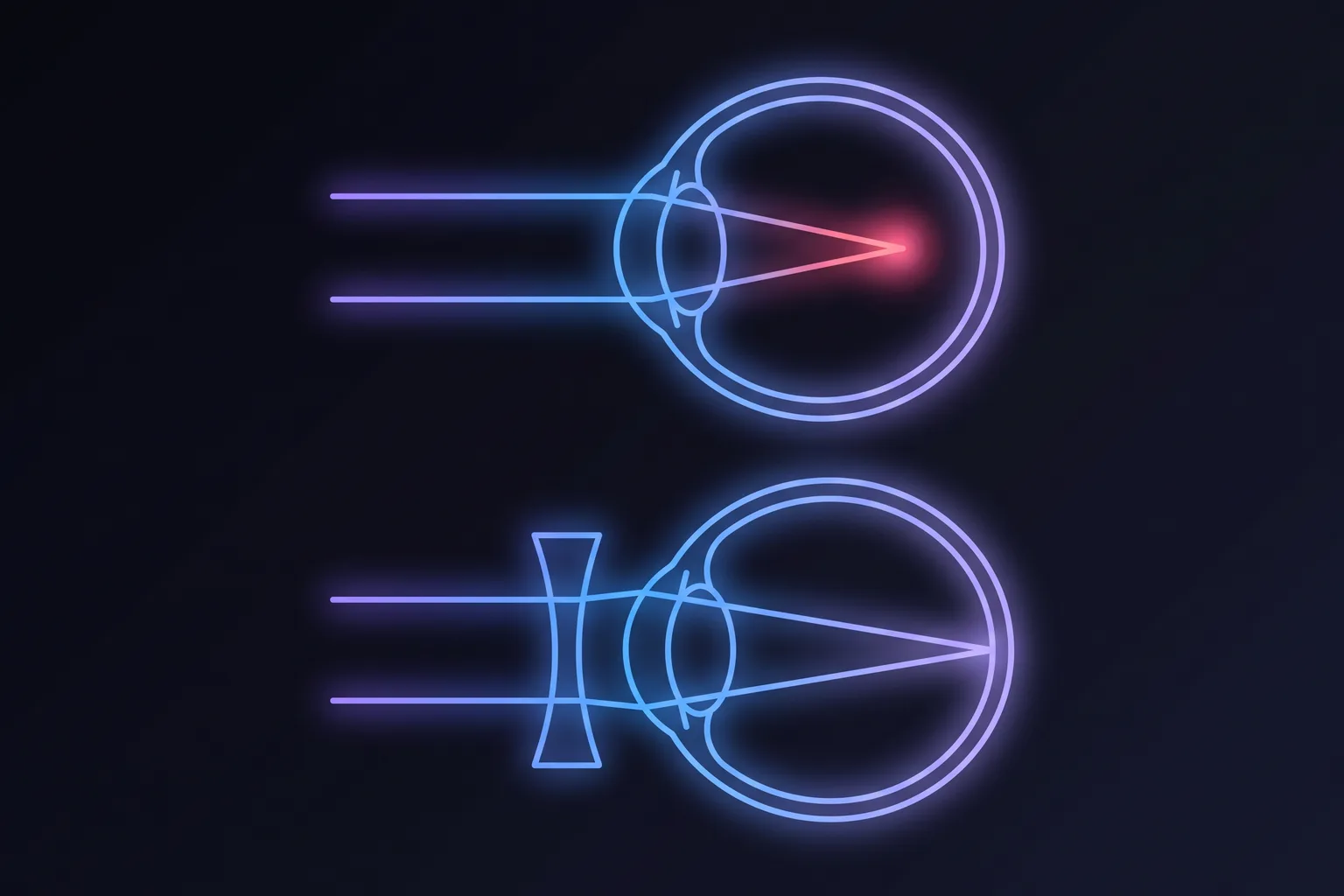
The mechanism first, because it makes everything below obvious. A myopic eye is usually a little too long from front to back, so light from far away comes to a focus just in front of the retina instead of on it, and distance goes soft while near stays sharp. That is all myopia is: an eye whose optics and whose length do not match. A spectacle lens for myopia is concave, it diverges the light slightly before the eye gets it, and the focus lands where it should. The eye itself is unchanged. Understanding that one sentence tells you why no pair of glasses can shrink an eyeball back, and why the lenses that genuinely slow myopia had to be built on a completely different idea.
What myopia glasses actually do, and what they cannot do#
Standard single vision lenses are what almost everyone is prescribed, and they are the right answer for correction: one power across the whole lens, distance made sharp, nothing more claimed. The American Academy of Ophthalmology puts it plainly, that glasses or contact lenses are the easy, common way to correct nearsightedness. Correction is not treatment. Take the glasses off and your eye is exactly as long as it was.
Two beliefs get in the way here, and both are worth killing early:
- "Wearing glasses makes your eyes lazy and your myopia worse." It does not. What actually happens is that myopia in a child progresses on its own timetable, the prescription is updated to keep up, and the glasses get blamed for the thing they are chasing.
- "A weaker prescription will train the eye and slow it down." This was tested properly and it backfired. In a two-year randomised trial of 94 children, Chung and colleagues deliberately undercorrected one group by about 0.75 dioptres. The undercorrected children progressed faster, not slower, and the trial was stopped. Wear the correction you were actually prescribed.
Myopia control lenses: the spectacles that change the trajectory#
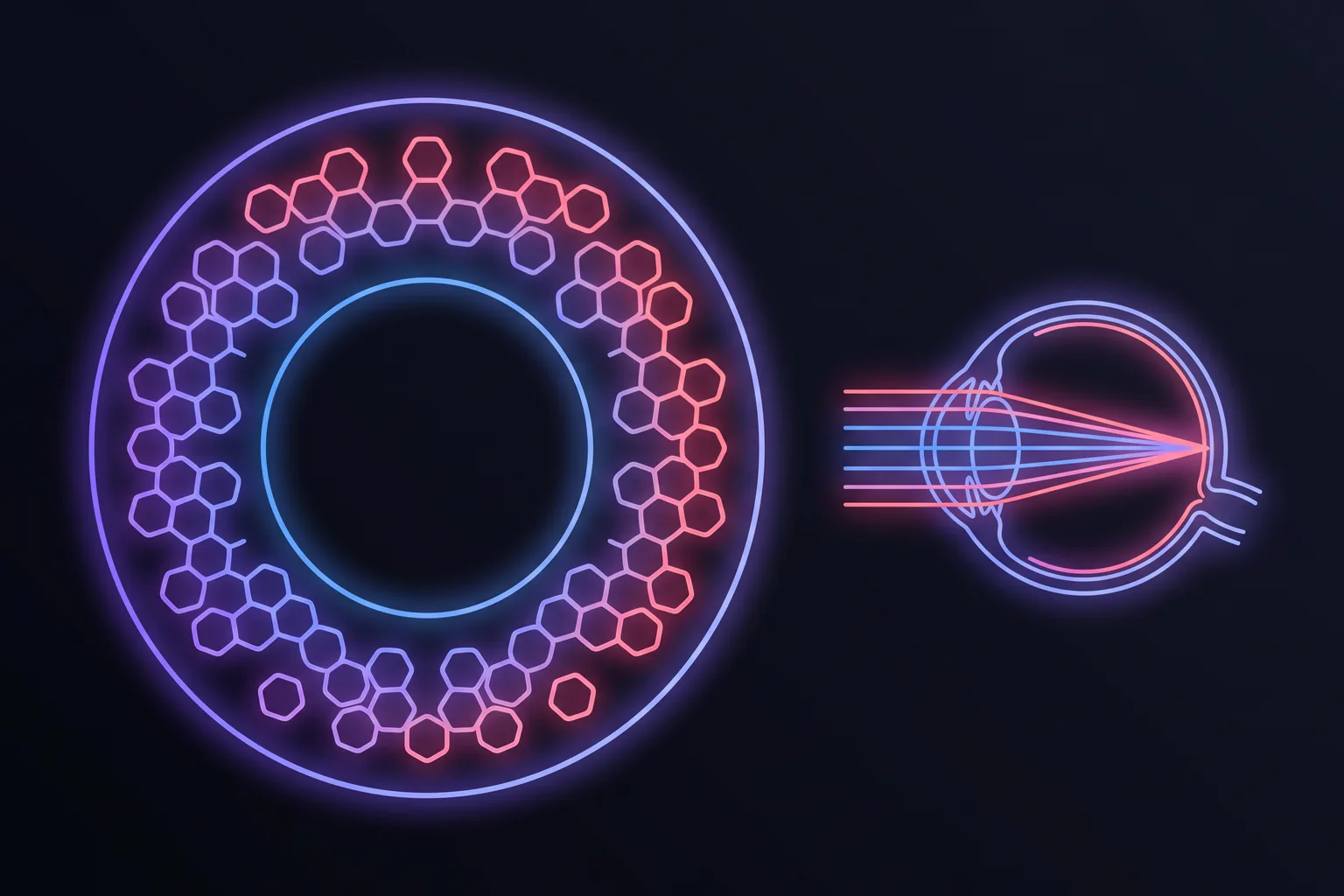
Myopia control (the trade calls it myopia management) is a genuinely different category, and it is the one part of this subject where the last decade produced real results. The idea: keep a clear central zone for vision, and fill the rest of the lens with a treatment structure that changes how light lands on the peripheral retina, which is the signal the growing eye appears to use to decide how long to become. The child sees normally through the middle. The periphery does the work.
Four designs dominate, and the figures below come from a 2025 review of the clinical evidence by Singh and De Gracia. Read them as reductions relative to a child wearing ordinary single vision lenses over the same period, not as promises of stopping myopia.
| Lens technology | How it works | What the trials showed |
|---|---|---|
| DIMS (Hoya MiYOSMART) | A honeycomb of small defocus segments around a clear centre | About 0.44 D and 0.34 mm less growth over 2 years, roughly 60% slower, holding through 6 years |
| HALT (Essilor Stellest) | Rings of highly aspherical lenslets creating a volume of myopic defocus | About 0.80 D less over 2 years (55%), up to 67% in children wearing them 12 hours a day |
| DOT (SightGlass Vision) | Thousands of light-scattering dots that lower peripheral contrast | About 0.33 D and 0.13 mm less, roughly 30%, over a 3-year trial |
| CARE (Zeiss MyoCare) | Concentric rings of refractive elements | About 0.14 D at one year, not statistically significant, axial effect around 25% |
| Progressive addition lenses | The standard varifocal, repurposed | Small and clinically negligible: not a myopia control lens |
| Single vision lenses | One power across the lens | The control arm in every trial above: correction only |
Now the caution nobody selling these lenses volunteers. Most of those trials were run or funded by the manufacturers, and when the independent synthesis is done the picture gets blurrier. The Cochrane living review and network meta-analysis of 104 randomised studies in 17,509 children (Lawrenson and colleagues, updated 2025) ranks orthokeratology as the most effective optical option for slowing eye growth in the short term, notes that more than half of the children dropped out of some of those trials, and says of the drops that higher-dose atropine may reduce progression while the effect of low-dose atropine could be small and is uncertain. The overall certainty of the evidence is dragged down by heterogeneity and by how the studies were run. Control lenses are worth discussing with an optometrist for a young, fast-progressing child. They are not a settled 60 percent guarantee.
Spectacles for myopia in adults: the part the shopping pages leave out#
Here is the sentence I could not find anywhere on the first page of results, and it is the one that decides what most readers of this article should buy. Every myopia control lens above was trialled in children, typically enrolled between six and thirteen years old, in the window when the eye is still growing. There is no adult efficacy trial to point at. Paying a premium for a control lens at 35 is buying evidence that was collected about someone else.
It also matters less than the internet implies, because adult myopia mostly settles. The AAO's own line is that a nearsighted child usually keeps getting more nearsighted, and that the prescription usually stabilises in their twenties. The eye stops lengthening because it stops growing.
What about the fear that a decade of screens is quietly making you more myopic? The honest answer is that the effect, if it exists in adults, is small and not clearly distinguishable from zero. The 2023 systematic review and meta-analysis on near work by Dutheil and colleagues found the odds of myopia raised by 21 percent in adults exposed to near work, and adult progression of 0.25 dioptres a year with a confidence interval running from 0.56 to plus 0.06: it crosses zero, which is the statistical way of saying the finding is not solid. In children the same analysis found 0.44 dioptres a year with a confidence interval that does not cross zero. The screen story is a children's story, and even there the evidence rated low certainty. Your screen day is doing plenty to your eyes, and I will get to that, but it is not the thing changing your prescription.
Eye care for myopia: what actually helps, by age#
If it is a child's myopia you are managing
The intervention with the cleanest evidence is not a lens at all, it is daylight. In a randomised trial published in JAMA in 2015, He and colleagues added 40 minutes of outdoor activity to the school day for 1,903 children in Guangzhou and followed them for three years. Cumulative incidence of myopia fell from 39.5 percent to 30.4 percent. Not progression in children who were already myopic, note: onset in children who were not. Both the AAO and the National Eye Institute repeat the same finding, with the NEI adding the refreshingly honest note that experts are not sure why it works. So the list is short: get them outside, keep reading and screens at a sensible distance with breaks, keep the correction accurate rather than deliberately weak, and take the myopia control conversation to an optometrist if progression is fast.
If it is your own myopia at a desk
Your problem is almost certainly comfort rather than progression. A long screen day collapses your blink rate and holds your focusing muscles at near for hours, which is what produces the burning, the late-afternoon blur and the headache, and which has nothing to do with how long your eyeball is. The fixes are the boring ones that work: break the near focus regularly, get the screen to arm's length with the top at eye level, kill glare, and get the prescription checked for screen distance specifically rather than for driving. Our full guide to reducing eye strain ranks those honestly by how much each one gives you. If your eyes feel heavy in a way that does not track your screen hours, that has its own set of causes.
The awkward part of that list is that the item doing most of the work, taking real breaks, is the one nobody actually does, because deep focus is exactly the state in which you never notice an hour has gone. That gap is why Pausr exists: I built it after uninstalling every other break app for interrupting at the worst possible moment. It will not change your prescription and I am not going to pretend otherwise. What it fixes is the part where the break never happens.
Do blue light glasses help with myopia?#
No, and it is worth being blunt because at least one page currently ranking for this query suggests blue-light filters may slow myopia progression in heavy screen users. There is no trial evidence for that claim. What there is: the 2023 Cochrane review of blue-light filtering spectacle lenses by Singh and colleagues, which found they may not reduce eye strain from computer use, probably make little or no difference to visual acuity, gave indeterminate results on sleep, and had no randomised evidence at all on macular health. If someone is upselling a blue-light coating on a myopia prescription, they are selling a coating, not a treatment. The money is better spent on a decent lamp, and the exposure question is its own subject.
Reading your prescription: what -2.00 actually means#
The sphere number on a myopia prescription is negative, measured in dioptres, and it has a neat physical meaning: divide one by it and you get your far point, the distance beyond which everything is blurred without correction. That single calculation explains your daily life better than any label.
| Prescription | Roughly where clear vision ends | In practice |
|---|---|---|
| -1.00 D | About 1 metre | Mild. Road signs and whiteboards go soft, a room is fine |
| -2.00 D | About 50 cm | The far side of a desk is blurred, faces at a table are not |
| -3.00 D | About 33 cm | A laptop at arm's length is already soft |
| -4.00 D | About 25 cm | Reading distance is the limit of sharp vision |
| -6.00 D | About 17 cm | High myopia begins here. Everything past a book is blur |
- High-index lenses matter from roughly -3.00 D onward. They bend light more per millimetre, so the lens is thinner and lighter, which is cosmetic and comfort, not optical quality.
- Anti-reflective coating is the one coating worth paying for: it removes the reflections that show up in night driving and on video calls, and it makes your eyes visible to other people rather than two discs of glare.
- A second pair set for screen distance is the underrated option for anyone over about 40 whose distance correction makes the monitor hard work. Ask for it by task, not by brand.
- High myopia, usually defined as -6.00 D or stronger, is a different medical category rather than just a bigger number, which is what the next section is about.
When myopia needs a doctor rather than a new pair of glasses#
Most myopia is an inconvenience corrected by a lens. A short list of situations is not, and it is worth knowing which is which:
- A sudden shower of new floaters, flashes of light, or a shadow or curtain moving across your vision. This is the retinal detachment pattern and it is an emergency, not an appointment: go to an emergency eye service the same day.
- High myopia, around -6.00 D or stronger. The AAO advises regular ophthalmologist exams to check the retina, because the risks of detachment, glaucoma and cataract are higher in a long eye. Once a year, not once a decade.
- A prescription changing fast in an adult, especially if it is only one eye, deserves an examination rather than a stronger lens.
- A child squinting, sitting close to screens, or complaining of headaches. Children rarely report blurred vision, because they have no comparison. The NEI notes myopia typically starts between six and fourteen, so a school-age eye test matters even when nobody has complained.
- Blurred vision that does not clear with correction, or vision loss in the central field, points at something other than refractive error.
None of that is meant to alarm anyone: this article is general information, not medical advice, and the overwhelming majority of short-sighted people need a lens and a check-up every couple of years. The line worth remembering is that glasses fix blur, and blur is not the only thing an eye can do wrong.
Frequently asked questions
What are the best spectacles for myopia?
Do glasses make myopia worse?
Do myopia control glasses work for adults?
Can myopia be cured or reversed?
Does screen time cause myopia?
What counts as high myopia?
What is the difference between myopia control and myopia correction?
Sources & further reading
- American Academy of Ophthalmology: Nearsightedness (myopia)
- National Eye Institute: Nearsightedness (myopia)
- Lawrenson et al., Interventions for myopia control in children: a living systematic review and network meta-analysis, Cochrane (2025)
- Singh & De Gracia, Next-Generation Spectacle Lenses for Myopia Control, Clinical and Experimental Optometry (2025)
- He et al., Effect of Time Spent Outdoors at School on the Development of Myopia Among Children in China, JAMA (2015)
- Dutheil et al., Myopia and Near Work: A Systematic Review and Meta-Analysis, IJERPH (2023)
- Chung et al., Undercorrection of myopia enhances rather than inhibits myopia progression, Vision Research (2002)
- Singh et al., Blue-light filtering spectacle lenses, Cochrane Database of Systematic Reviews (2023)
- International Myopia Institute: evidence reports on myopia management
- World Health Organization: World report on vision (2019)