Written by Alex Ren
Updated on 17 min read
Does the Kindle have blue light? What each of your screens actually emits, measured
Quick summary Yes, if your Kindle has a front light, and every model Amazon currently sells does: the small LEDs that illuminate the page emit blue wavelengths, exactly like any other white LED. A basic e-ink Kindle with the light switched off emits none at all, because the screen only reflects light already in the room. The interesting part is not whether a screen emits blue light, since they all do and at almost the same colour. It is how much, and there the gap between a Kindle and a tablet is close to a factor of ten.
In this article
- The short answer, screen by screen
- Does the Kindle have blue light?
- How much blue light, in actual numbers
- Is a Kindle actually better than a phone before bed?
- Do TVs have blue light?
- How to turn off blue light on iPhone, and on everything else
- Do sunglasses block blue light?
- What none of these settings touch
- When to get your eyes checked instead
- Frequently asked questions
The short answer, screen by screen#
- Kindle with the front light off: no emitted light at all. An e-ink screen is reflective, like paper. What reaches your eye is whatever your lamp is putting out.
- Kindle with the front light on: yes, and it measured the lowest of any lit screen in the comparison below, at roughly a tenth of a tablet's circadian-relevant light.
- Phone, tablet, laptop: yes, and these are the ones the sleep research was actually done on.
- TV: yes, and the usual reassurance about distance is only half right. Explained below.
- Sunglasses: they block blue light very effectively, which outdoors in the daytime is mostly a reason not to wear them indoors.
Does the Kindle have blue light?#
The question has three different answers because three different devices get called a Kindle, and most pages answering this question treat them as one.
- An e-ink Kindle with no light, or with the light turned off. It emits nothing. E-ink is a reflective display: tiny charged pigment particles rise and sink in microcapsules to make the page look light or dark, and you read it the way you read paper, by the light in the room. Switch the front light off and the device stops being a light source entirely.
- A front-lit e-ink Kindle: Paperwhite, Colorsoft, Scribe, and the current base model. It emits blue light, because the LEDs are white LEDs. Every Kindle Amazon sells today has a front light; the ones without are older base models.
- The Kindle app on a phone or tablet, or a Fire tablet. This is not an e-reader at all. It is an ordinary LCD or OLED, and it belongs in the phone and tablet row of the table below.
One technical correction worth making, because the pages ranking for this query get it wrong and it changes the answer: a Kindle is front-lit, not backlit. On a phone, a backlight sits behind the panel and shines through it, straight out at your eye. On a Kindle, LEDs sit in the bezel and shine sideways across a thin light guide laid over the screen, which throws the light down onto the e-ink layer, where it bounces back up to you. You are still reading reflected light. It is simply reflected light the device supplies itself, rather than light your lamp supplies.
That distinction is not cosmetic. It is why the same white LEDs produce a much smaller dose at your eye in a Kindle than in a tablet, and it is the mechanism behind the numbers in the next section.
How much blue light, in actual numbers#
Almost nobody writing about this measures anything. A 2015 paper in Frontiers in Public Health did, putting devices at their manufacturer's recommended reading distance and recording what actually arrived at the eye. Melanopic lux is the column that matters here: it weights light by the response of the retinal cells that set your body clock, which is the pathway blue light is famous for.
| Device | Peak wavelength | Photopic lux | Melanopic lux |
|---|---|---|---|
| iPad Air, 9.7 inch, at 35 cm | 445 nm | 318.5 | 302.3 |
| iPhone 5s, 4 inch, at 22.5 cm | 450 nm | 51.4 | 54.5 |
| Kindle Paperwhite, 6 inch, at 35 cm, light at 50 percent | 455 nm | 38.7 | 34.6 |
Read the first column and the last one together, because that is the whole argument. The peak wavelength is the same on all three, within ten nanometres. That is not a coincidence: a white LED is a blue LED with a phosphor coating over it, so a spike in the blue is how all of them make white. Any page that tells you a device emits blue light has told you nothing that distinguishes it from any other device. Meanwhile the melanopic column spans nearly a factor of ten, and that is the number with a biological consequence.
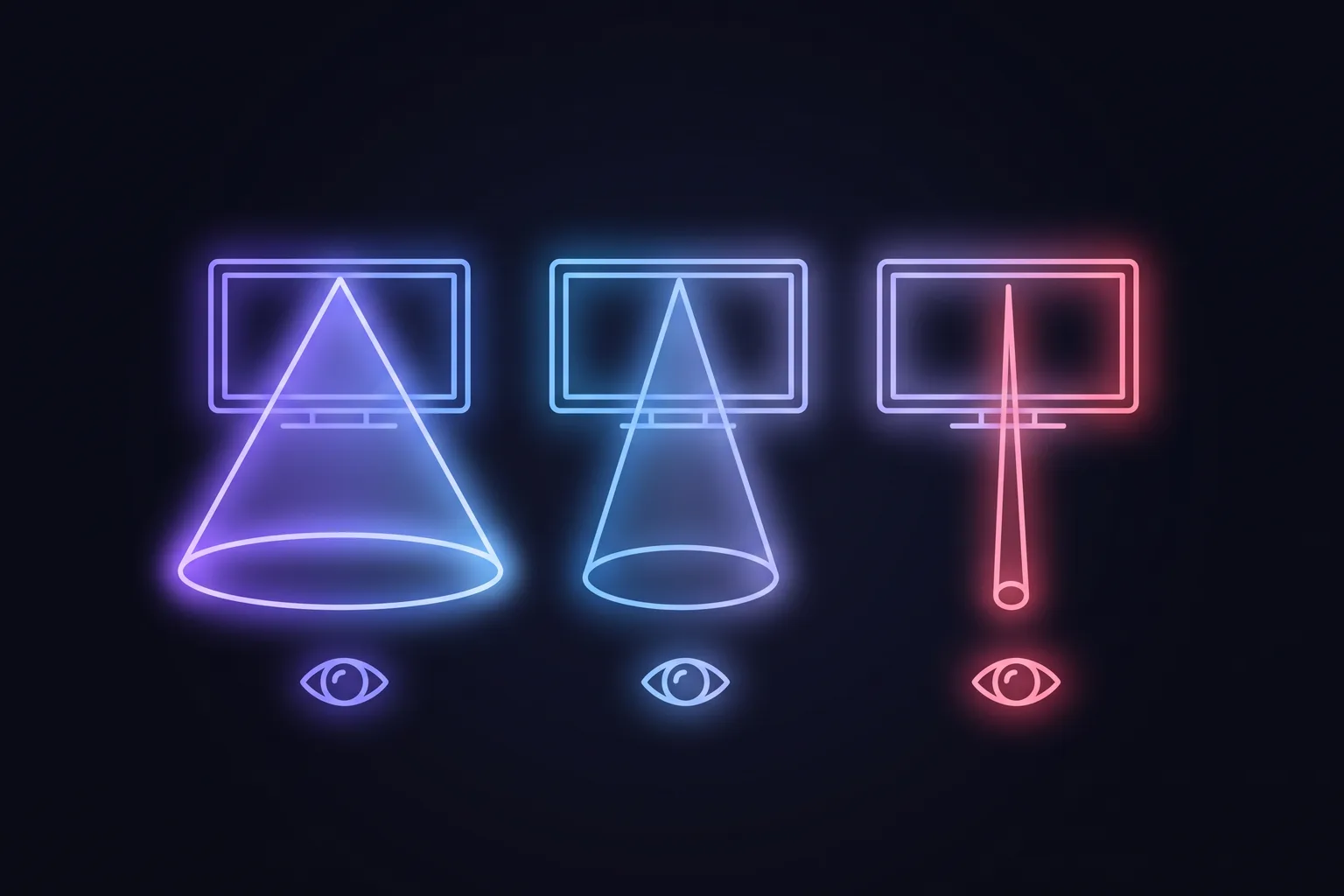
Two honest caveats. These are 2015 devices, and the Kindle was measured with its light at half brightness while the tablet was not, so the ratio is a fair reflection of ordinary use rather than a physical constant. Turn a Paperwhite up to maximum in a dark room and you close some of that gap yourself. The ranking, though, is structural: front lighting on a reflective screen puts less light into your eye than a backlight aimed at it, and a 6 inch screen puts less in than a 9.7 inch one.
For scale, the American Academy of Ophthalmology notes that blue light exposure from screens is much less than what you get from the sun, and no more damaging. An overcast day outdoors runs into the thousands of lux and direct sun well past a hundred thousand. Every device in that table is a rounding error against a walk to the shops.
Is a Kindle actually better than a phone before bed?#
For the light, yes, and there is a well-known experiment behind that answer, although it is routinely cited for more than it showed. Chang and colleagues (2015) had people read for four hours before bed, on some nights from a light-emitting screen and on others from a printed book. The screen nights suppressed evening melatonin by about 55 percent, while the print nights suppressed none. People took longer to fall asleep, their body clock shifted later, and they were measurably less alert the next morning.
The detail that matters, and that the pages citing this study tend to drop: the device was an iPad, not a Kindle. The study did not test an e-reader with a front light, so it cannot tell you what a Paperwhite does. What it can tell you is more useful than a headline. The printed book was read under reflected light, peaking around 612 nm in the orange, against roughly 450 nm for the screen. An e-ink Kindle with its front light off is optically in the print condition: it emits nothing, and what reaches your eye is your lamp, bounced. A front-lit Kindle sits between the two, much nearer the print end.
So the practical answer is yes, a Kindle is a better bedtime screen than a phone, for reasons that are physical rather than tribal. It is also true that the size of that advantage has been oversold, for a reason that becomes obvious in the next section.
Do TVs have blue light?#
Yes. An LED-backlit LCD and an OLED both make white the same way every other display does, so a television emits the same blue-peaked spectrum as the phone in your hand.
The usual reassurance is that a TV is far away, so it barely counts. That is only half the story, and the missing half is size. What reaches your eye from a large flat panel depends on how bright it is and on how much of your field of view it fills. A 55 inch screen at two and a half metres fills roughly the same slice of your vision as a phone held at thirty centimetres. Distance and size push in opposite directions and largely cancel, which is why an evening of television is not obviously gentler on your body clock than an evening of scrolling.
What genuinely differs is everything other than the light. You do not hold a TV twenty centimetres from your face, you are not holding a focus at reading distance for hours, and you blink normally while watching it. Those are the mechanisms behind sore eyes at the end of a working day, and a television does not impose any of them. If your eyes hurt, the TV is unlikely to be the culprit; if you are not sleeping, it is as plausible a suspect as your phone.
How to turn off blue light on iPhone, and on everything else#
On an iPhone the setting is called Night Shift, and it warms the display rather than switching anything off. Open Settings, then Display & Brightness, then Night Shift, and turn on Scheduled. You can set it to run from sunset to sunrise, or on a custom schedule, and drag the colour temperature slider toward the warm end. To toggle it immediately, open Control Centre, press and hold the brightness slider, and tap the Night Shift button. Apple documents both routes.
- Android: Settings, Display, then Night Light or Eye Comfort Shield, depending on the manufacturer. Same scheduling options.
- Mac: System Settings, Displays, Night Shift.
- Windows: Settings, System, Display, Night light.
- Kindle: the models with a warm light setting let you dial the front LEDs toward amber, on a schedule, from the top toolbar. On any Kindle, turning the front light down is the more effective control, and turning it off in a lit room is the most effective one.
- TV: switch out of the shop-floor picture mode. Filmmaker, Cinema or Warm modes are dimmer and considerably warmer than the default, which is tuned to look bright under showroom lighting.
Now the part the how-to articles leave out. Duraccio and colleagues (2021)00060-7/abstract) ran an actual randomised trial on this, with 167 adults over seven nights, split three ways: phone with Night Shift on, phone with Night Shift off, and no phone before bed. Night Shift produced no significant difference in any sleep outcome compared with the unfiltered phone. Among good sleepers, putting the phone away beat both phone conditions. The authors' conclusion was that the problem is not only short-wavelength light: what a phone does to your evening is also about engagement and arousal, and a warmer screen does not make a group chat less stimulating.
Do sunglasses block blue light?#
Yes, and more thoroughly than anything marketed for the job indoors. A sunglass lens works by cutting visible light across the board, blue included, and as a rough rule a lens that transmits 43 percent of visible light or less is filtering out most of the blue along with it. Brown, amber and copper tints cut proportionally more of the short wavelengths than a neutral grey does.
The catch is that this is the one situation where blocking blue light is working against you. Daytime blue light is the signal that anchors your body clock, and the outdoor light you get in the morning does more for your sleep that night than any evening filter will. Sunglasses have good reasons to exist: glare, comfort, UV, migraine and light sensitivity. Circadian health is not one of them, and wearing them indoors at a screen is the wrong tool pointed at the wrong problem.
The related question, whether tinted glasses sold specifically for screen use do anything for tired eyes, has its own answer and it is not an encouraging one. We cover it properly in the guide to reducing eye strain, and the behavioural side of blue light, meaning when you get it rather than which lens you put in front of it, sits with the 20-20-20 rule.
What none of these settings touch#
There are two separate questions hiding inside every blue light article, and keeping them apart is most of the value here. One is about sleep, where light genuinely matters and where dose and timing are the levers. The other is about how your eyes feel at six in the evening, and blue light has very little to do with it.
On that second question the AAO is unusually direct: there is no scientific evidence that blue light from digital devices damages the eye, and the reason screens make eyes ache is that most of us blink less when looking at one. Blink rate drops by roughly half at a screen, and many of the remaining blinks are incomplete, so the tear film thins and the surface gets irritated while the focusing muscles hold near distance for hours without a break. No colour temperature setting on any device in this article changes either of those. This is also why dark mode does not deliver what people expect from it: it is a display preference aimed at a problem that lives in your blink rate.
Which puts the whole device question in proportion. Choosing a Kindle over a tablet for bedtime reading is a reasonable, evidence-backed decision worth maybe an hour of your evening. Switching on Night Shift is free and pleasant and, on the trial evidence, close to inert. Looking away from the screen regularly during the day is the one that acts on the actual mechanism, and it is the one nobody has a settings toggle for.
When to get your eyes checked instead#
If you are here because your eyes hurt rather than because you are curious about e-ink, the device settings are not the investigation you need. Book an eye test if:
- Blurred vision does not clear when you blink or look into the distance.
- You get headaches that reliably follow screen work, or eye pain rather than eye tiredness.
- You notice new floaters, flashes of light, or a shadow across part of your vision. This is urgent and is not eye strain.
- One eye is red and painful, or your vision has changed in one eye only.
- Discomfort persists despite regular breaks, a sensible screen distance and lighting that matches the room.
- You have not had a test in two years, which remains the most likely single explanation for screen discomfort in an adult who is otherwise doing everything right.
Frequently asked questions
Does the Kindle have blue light?
Does the Kindle Paperwhite have blue light?
Do Kindles emit blue light even with the light off?
Do TVs have blue light?
How do I turn off blue light on my iPhone?
Does Night Shift actually help you sleep?
Do sunglasses block blue light?
Does blue light from screens damage your eyes?
Sources & further reading
- Gringras et al. (2015), Frontiers in Public Health: Bigger, brighter, bluer-better? Current light-emitting devices
- Chang et al. (2015), PNAS: Evening use of light-emitting eReaders negatively affects sleep, circadian timing and next-morning alertness
- Duraccio et al. (2021), Sleep Health: Does iPhone night shift mitigate negative effects of smartphone use on sleep outcomes?
- American Academy of Ophthalmology: Should you be worried about blue light?
- American Academy of Ophthalmology: Computers, digital devices and eye strain
- Apple Support: Use Night Shift on your iPhone, iPad and iPod touch
- American Academy of Ophthalmology: Are blue light glasses worth it?
- Sleep Foundation: How blue light affects sleep