Written by Alex Ren
Updated on 16 min read
Eye strain headache: the causal chain behind it, and how to tell it from the headache that merely looks like one
Quick summary An eye strain headache is a dull, pressing ache across the brow, the temples or behind the eyes that builds during sustained close work and fades within an hour of stopping. It is real, it has a traceable mechanism, and it is also blamed for far more head pain than it actually causes: most persistent headaches are a primary headache disorder, and a new prescription will not touch them. The useful question is therefore not what cures an eye strain headache, but whether yours is one at all, which is what the timing test below is for.
In this article
- The causal chain: how a screen day turns into a headache
- Can eye strain cause headaches? Yes, and less often than you think
- Eye fatigue headache, tension headache or migraine: the timing test
- Eye strain symptoms with burning eyes: when both arrive together
- Eye strain headache relief: what to do in the next ten minutes
- Eye strain headache treatment: what actually changes it, in order
- When a headache needs a doctor rather than a screen break
- Frequently asked questions
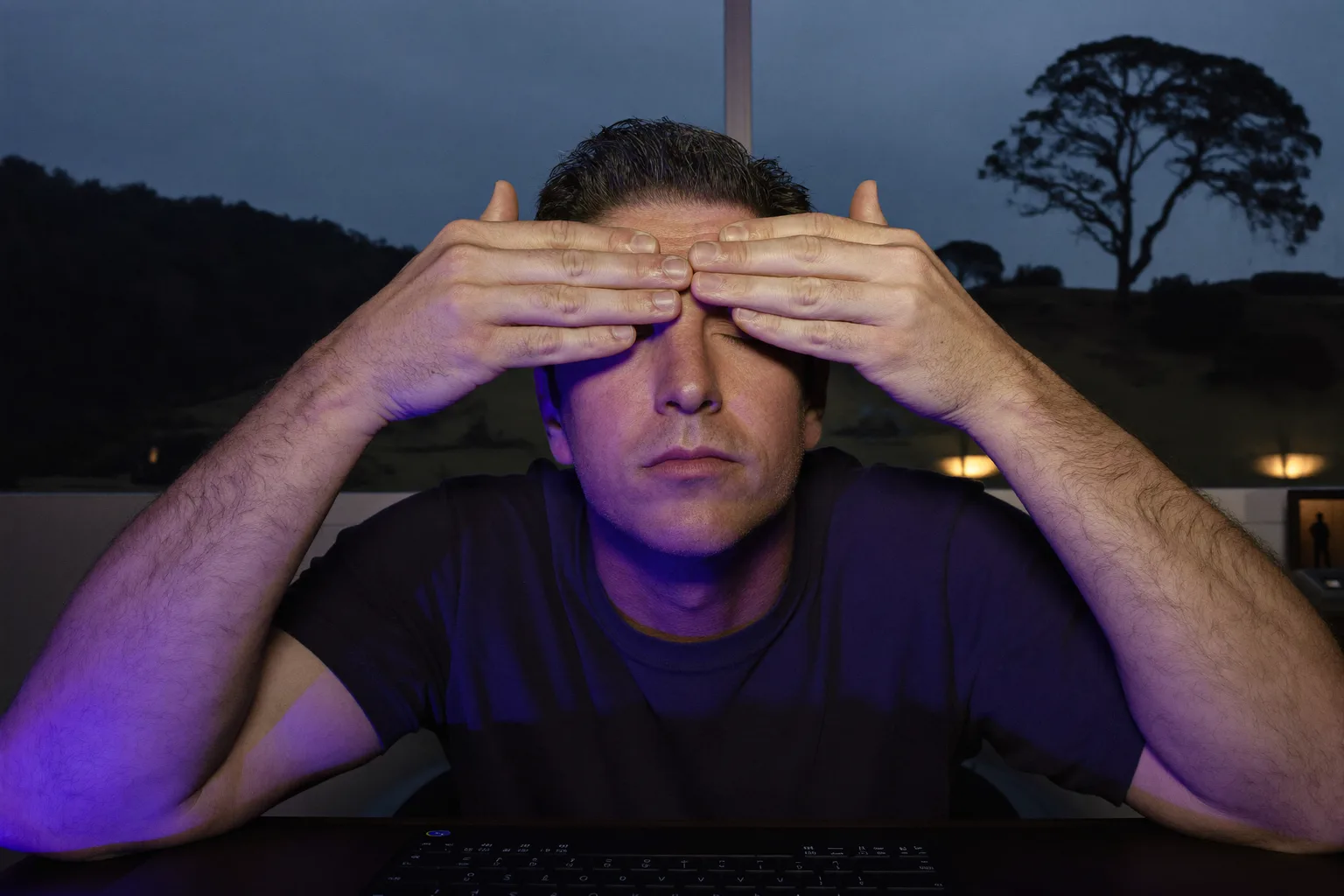
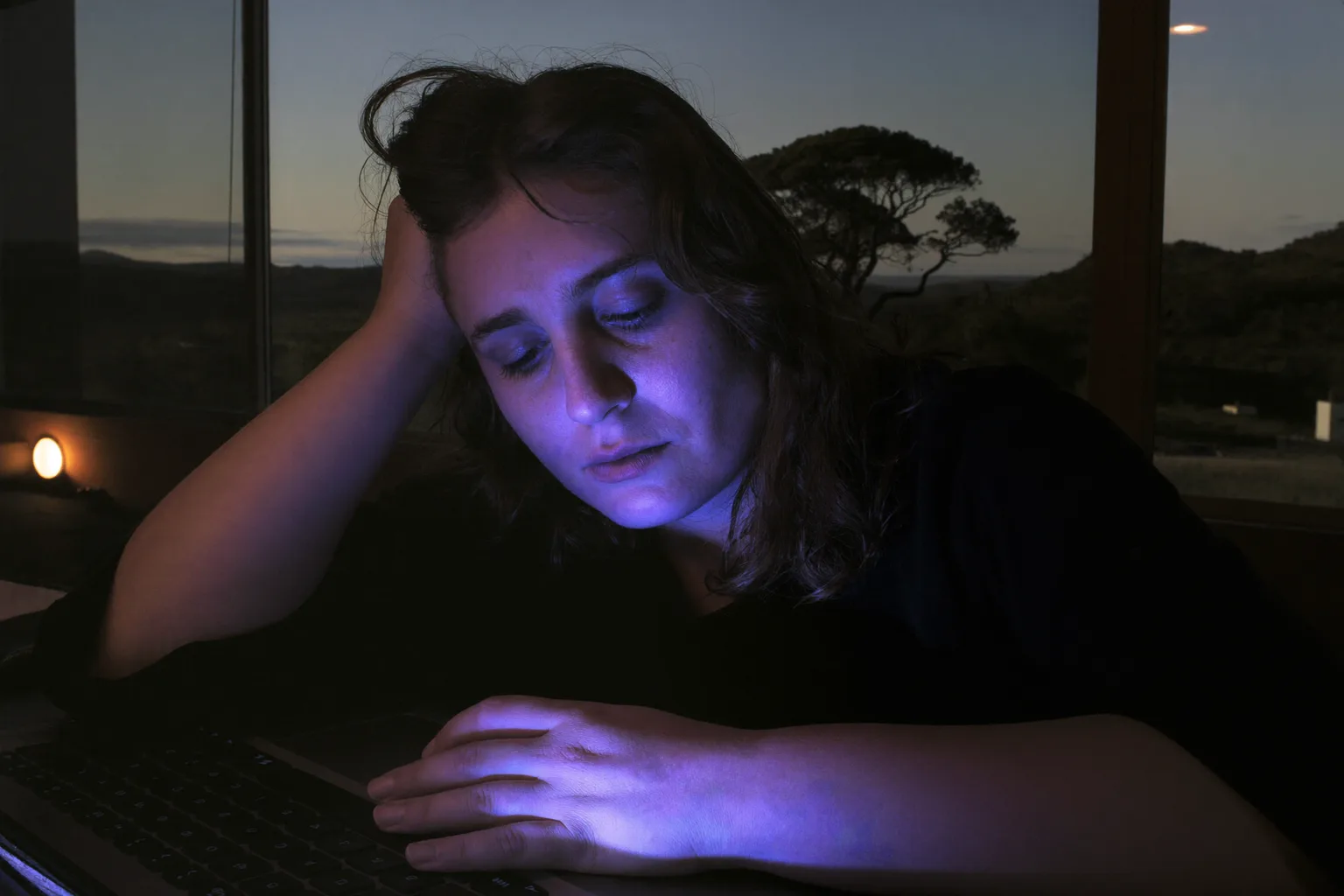
The clinical word for the whole picture is asthenopia, and the American Optometric Association lists its symptoms together for a reason: eyestrain, headaches, blurred vision, dry eyes, and neck and shoulder pain. That grouping is the first clue. A headache and strained eyes at the end of a screen day are not two separate problems that happen to coincide, they are the far end of one chain of small efforts that your eyes and the muscles around them have been making for hours. Understanding the chain matters more than memorising a list of remedies, because it tells you which link is yours, and every effective fix below works by breaking a specific link.
The causal chain: how a screen day turns into a headache#
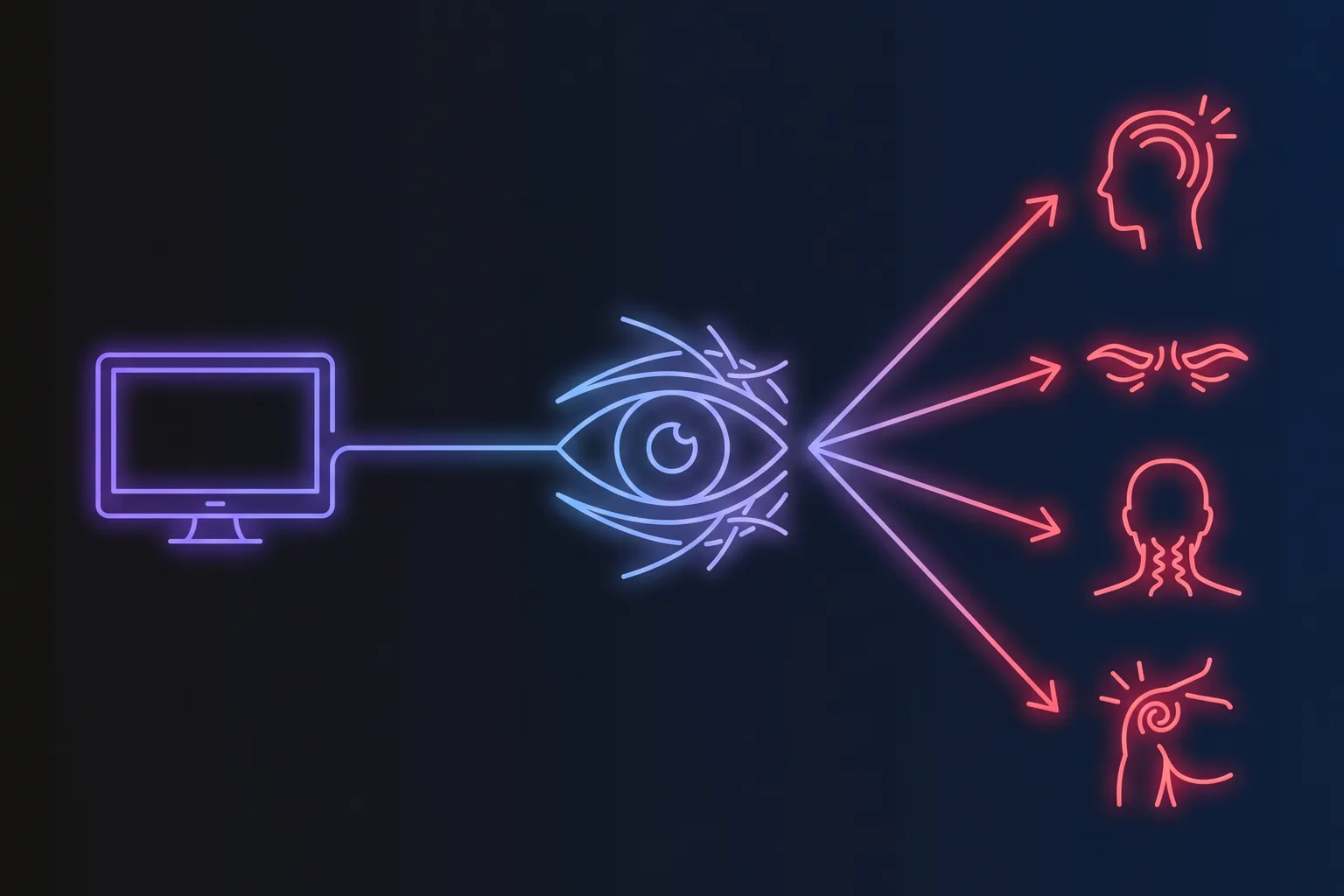
Nothing in your eyeball hurts. The eye has no pain receptors of the kind that produce a headache, which is why the ache sits in your brow, your temples and the ridge above your eyes rather than in the eye itself. What is actually happening is four separate loads stacking up in the tissues around the eye, and each one is worth naming because each one has a different fix.
- Sustained focusing effort. Close work asks the ciliary muscle inside the eye to hold a contraction for hours, and asks the muscles that converge both eyes on the same near point to do the same. Neither was designed for a static eight-hour hold, and the fatigue signal they produce is felt as a deep ache behind and around the eyes.
- A collapsed blink rate. This is the one most people underestimate. The American Academy of Ophthalmology puts it in numbers: we blink around 15 times a minute normally, and only 5 to 7 times a minute at a computer. The tear film breaks up between blinks, the ocular surface dries out, and a dry surface is genuinely irritating rather than merely uncomfortable.
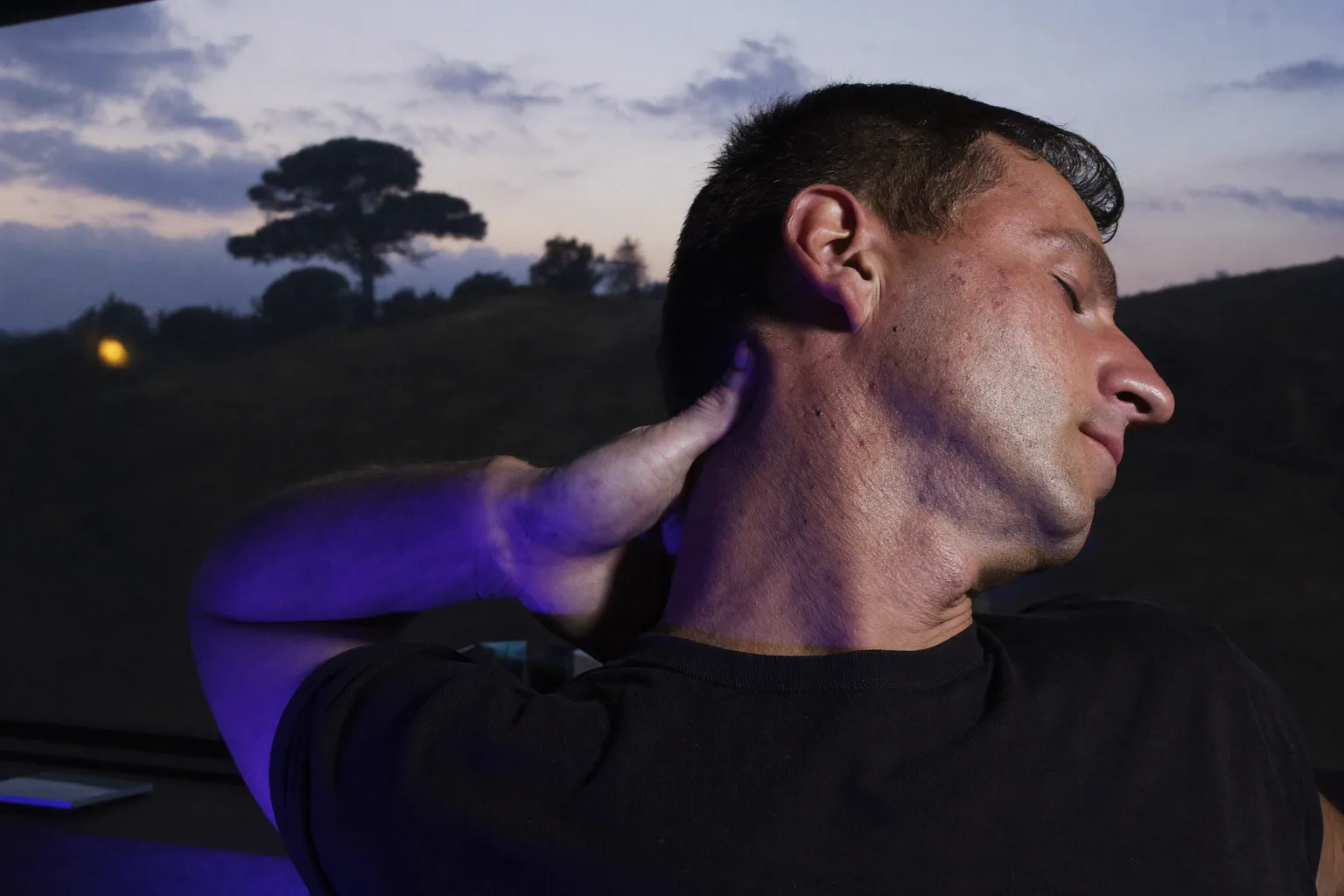
- Pericranial and neck muscle tension. A screen that is too high, too far, or too dim pulls your head forward and holds your brow and scalp muscles slightly contracted all day. Pain from those muscles refers forward into exactly the band across the forehead and temples that people describe as an eye strain headache.
- An optical mismatch you are compensating for. An uncorrected or slightly wrong prescription, an astigmatism nobody has measured, or a screen set at a distance your glasses were not made for, all mean your focusing system spends the day hunting rather than settling. This is the link that a remedy cannot fix and only an eye test can.
Can eye strain cause headaches? Yes, and less often than you think#
Here is the sentence the clinic blogs on this query will not write, because it does not end in booking an appointment. Eye strain is a genuine cause of headache and a poor explanation for most of them. The American Migraine Foundation states it plainly: most headaches are not due to eye strain, they are due to a primary headache disorder such as migraine or tension-type headache, and for the vast majority of people changing their glasses, adding prisms or doing vision therapy is not useful.
That is not a reason to dismiss your symptoms, it is a reason to be precise about them. The screen-related version of this problem is common enough on its own: a 2023 meta-analysis in Scientific Reports pooling studies across tens of thousands of participants found that roughly two out of three screen users report symptoms of computer vision syndrome. What the AMF is warning against is the assumption that runs the other way, that a headache which happens to arrive on a working day must therefore be an eye problem. Most of the time it is not, and the cost of guessing wrong is months of new lenses that change nothing.
Eye fatigue headache, tension headache or migraine: the timing test#
There is no scan for this and no clinic will run one. What separates the three in practice is pattern, and you can collect the pattern yourself in about a week by noting three things each time it happens: when it started, where it sits, and what makes it stop. The table below is the shortcut, and the single most useful line in it is the last one.
| Eye strain headache | Tension-type headache | Migraine | |
|---|---|---|---|
| When it starts | During or after sustained close work, typically building through the afternoon | Any time, often with stress or a long static posture | In attacks, sometimes with warning signs, unrelated to your screen hours |
| Where it sits | Brow, temples, behind or around the eyes | A band of pressure around the whole head | Usually one side, throbbing rather than pressing |
| What comes with it | Burning or gritty eyes, blurred vision that clears on blinking, dryness | Tight neck and shoulders, scalp tenderness | Nausea, sensitivity to light and sound, visual aura |
| What relieves it | Stopping the near work, real distance viewing, rest | Movement, posture change, relaxation | Dark, quiet, sleep, migraine-specific medication |
| The giveaway | It tracks your screen day and it is gone by Sunday | It does not care what your eyes were doing | It arrives as an attack, not as a slow build |
The giveaway row is the whole test. An eye strain headache is dose dependent: heavy screen days produce it, light days do not, and a genuine weekend away from close work clears it. If yours turns up on a Saturday morning with no screen in sight, or holds steady whatever your workload, then eye strain is not the mechanism, and the useful next step is a GP rather than an optician. Eyes straining and headache going together is what makes the diagnosis, not either symptom alone.
Eye strain symptoms with burning eyes: when both arrive together#
The combination people describe most often is not a headache alone, it is burning, gritty eyes plus a dull frontal ache plus a general flatness by mid-afternoon. That trio has a single most likely explanation, and it is the blink rate. Your tear film needs a complete blink every few seconds to stay intact. At the 5 to 7 blinks a minute the AAO measured at a computer, it does not get one, the surface dries in patches, and the burning is the surface telling you so. The National Eye Institute lists long stretches of screen use among the everyday situations that reduce blinking and provoke exactly this.
Two practical consequences follow. First, if burning is the loudest symptom, treat the surface: deliberate full blinks, lubricating drops if you need them, and a look at the air in the room, because air conditioning and a fan pointed at your face both accelerate tear evaporation. Second, be honest about what dryness explains and what it does not. A dry surface makes a screen day harder to tolerate and it feeds the headache, but it is not the whole of it, and drops alone rarely settle the ache. If the dryness is the dominant complaint rather than the headache, that has its own set of causes worth reading.
Eye strain headache relief: what to do in the next ten minutes#
Relief and treatment are different questions, and this is the short one. Headache from eye strain relief works by removing the load rather than by adding anything, so the order below is simply the order of how much load each step removes.
- Stop the near work and look properly far away for a couple of minutes. Not at the far wall of a small room. Out of a window if there is one, because your focusing system only fully relaxes at genuine distance.
- Blink deliberately, fully, twenty times. It feels ridiculous and it resurfaces the tear film, which is the fastest thing you can do about the burning half of the symptom.
- Move your head and shoulders. Stand, roll the shoulders back, let the neck lengthen. If the ache is mostly the pericranial link of the chain, this is the step that touches it.
- Fix the light before you sit back down. Glare on the screen and a bright window behind it both make your eyes work harder for the rest of the day, and both take ten seconds to solve.
- Drink some water and check when you last ate. Dull, unremarkable causes account for a surprising share of afternoon headaches, and the NHS lists dehydration and skipped meals among the usual suspects.
- Painkillers are a reasonable last step, not a first one. They work on the pain and not on any of the four loads. Regular reliance on them is itself a recognised cause of headache, which is a trap worth knowing about.
Eye strain headache treatment: what actually changes it, in order#
If the headache comes back every working day, relief is not the goal. The list below is the honest ranking of eye strain headache treatment by how much difference each item makes, and it is deliberately unglamorous at the top and expensive at the bottom.
- Break the near focus regularly, all day. This is the only intervention that addresses the biggest link in the chain, and it is the one with the least compliance. The research on 20-20-20 style habits found that students who practised them reported fewer asthenopic symptoms, and that the overwhelming majority did not practise them consistently. The prescription is not the hard part. Remembering it during deep focus is.
- Set the geometry once and stop thinking about it. The AOA is specific: the screen 15 to 20 degrees below eye level, measured from its centre, and 20 to 28 inches from your eyes. The AAO says about arm's length. Getting this wrong loads the neck and brow every hour of every day.
- Treat the dry surface if burning is part of it. Deliberate blinking first, lubricating drops second, and the fan or the air conditioning vent pointed somewhere other than your face.
- Get the refraction checked for screen distance specifically. Not for driving. If you are over about 40, or you have never been tested, this is the step that occasionally resolves the whole thing at once, and it is why the eye test belongs on the list even though it is not the first item.
- Blue light glasses are not a treatment for this. The 2023 Cochrane review of blue-light filtering lenses found they may not reduce eye strain from computer use. The AAO makes the related point that computer glasses, which are a real thing for intermediate distance, are not the same product as blue-light blocking glasses. If a headache is being treated with a coating, nothing is being treated.
The awkward part of that ranking is that the item doing most of the work sits at the top and depends entirely on you noticing the time. That is the gap Pausr was built for, and I will be straight about the limit of it: it does not fix your prescription, your lighting or your desk. What it fixes is the part where the break never happens, which is the part every study on this quietly identifies as the failure point. The full guide to reducing eye strain ranks the wider set of fixes, and the 20-20-20 rule has its own article on why the numbers matter less than the adherence.
When a headache needs a doctor rather than a screen break#
Most headaches at a desk are ordinary and this section is not meant to alarm anyone. It exists because the pattern that matters is easy to state, and because one eye emergency in particular presents as a headache and gets mistaken for eye strain.
- Sudden blurred vision with severe eye pain, a headache, nausea or vomiting, or rainbow-coloured halos around lights. This is the acute angle-closure glaucoma pattern, and the AAO calls it a true eye emergency that needs care immediately rather than an appointment. It is the single reason this section is not optional.
- A headache that starts suddenly and is extremely painful, or comes with a seizure, weakness or numbness in the face or body, difficulty speaking, drowsiness or confusion, or loss of vision. The NHS advice on these is emergency services, not a wait-and-see.
- A headache with a very high temperature, a stiff neck, or bright light becoming painful. Same category, same urgency.
- Jaw pain when chewing or tenderness of the scalp and temples, especially over 50. This is the giant cell arteritis pattern, it threatens sight, and it needs urgent assessment.
- A headache brought on by coughing, sneezing, bending or exercise, or one that keeps returning despite everything above. Worth a GP appointment rather than another pair of glasses.
- Vision that does not clear when you blink or rest, double vision, or a change that is only in one eye. That points at the eye rather than at strain, and it needs an examination.
This article is general information rather than medical advice. The line worth carrying away from it is the same one the timing test gives you: a headache that tracks your screen day is a habits problem you can act on this afternoon, and a headache that is sudden, one-sided, progressive or accompanied by any of the above is a see-someone problem, today.
Frequently asked questions
Can eye strain cause headaches?
What is the cure for an eye strain headache?
What is the best eye strain headache remedy in the moment?
How long does an eye strain headache last?
Where is an eye strain headache located?
Can pink eye cause a headache and fatigue?
Do blue light glasses help with eye strain headaches?
Sources & further reading
- American Optometric Association: Computer vision syndrome
- American Academy of Ophthalmology: Computers, Digital Devices and Eye Strain
- American Migraine Foundation: Do I Need To Have My Eyes Checked If My Head Hurts?
- NHS: Headaches
- American Academy of Ophthalmology: What Is Glaucoma?
- National Eye Institute: Causes of Dry Eye
- Prevalence of computer vision syndrome: a systematic review and meta-analysis, Scientific Reports (2023)
- The 20/20/20 rule: practicing pattern and asthenopic symptoms among university students, PMC (2023)
- Singh et al., Blue-light filtering spectacle lenses, Cochrane Database of Systematic Reviews (2023)
- American Optometric Association: Comprehensive eye exams