Written by Alex Ren
Updated on 12 min read
How to reduce eye strain: what works right now, and what stops it coming back
Quick summary Eye strain relief is really two jobs: settling your eyes in the next five minutes, and changing the handful of things that keep causing it. Most articles hand you either a list of exercises or a list of tips and leave you to guess which ones matter. Here is both, sorted honestly by how much each one actually helps, from someone who has spent five years looking for the version that sticks.
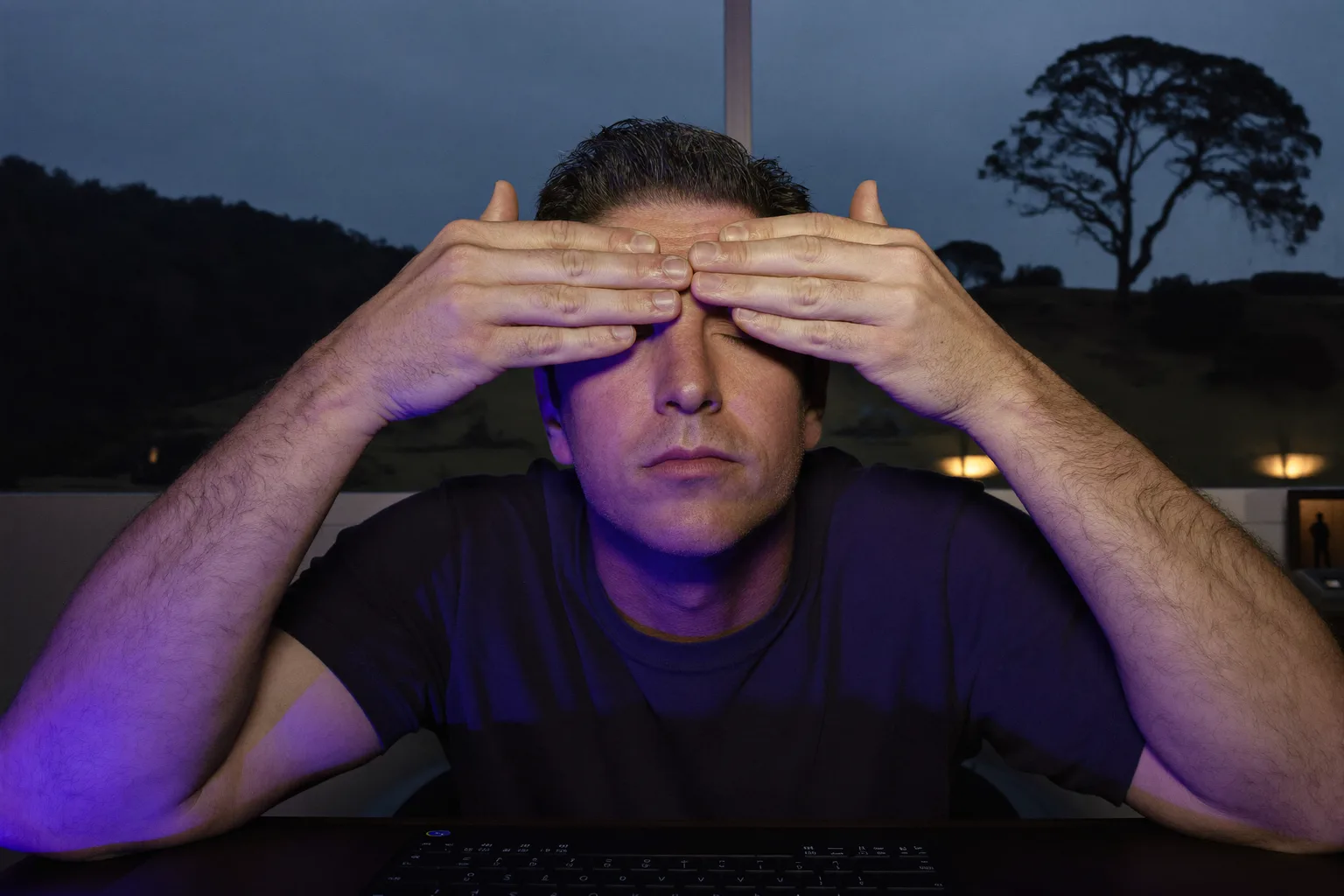
Quick orientation before the fixes. Eye strain (the clinical word is asthenopia) is fatigue, not damage: at a screen your blink rate collapses and your focusing muscles hold near focus for hours, so the eyes get dry and the focusing system gets tired. That is the whole mechanism, confirmed by the American Optometric Association. The good news buried in that sentence: because it is fatigue, it responds to rest and a few environmental changes, and almost none of it needs a doctor. If you are not sure your symptoms are strain at all, start with what actually causes heavy, tired eyes, then come back here for the fixes.
Eye strain symptoms: first, make sure that is what you have#
Eye strain has a recognisable signature. You will usually have some mix of the following, worse the longer you have been at a screen and better after time away from it:
- Dry, gritty or burning eyes, often worst by late afternoon.
- Blurred vision that clears when you blink or look into the distance.
- Aching, tired eyes, sometimes with a headache around or behind them.
- A twitching eyelid that flutters for a few seconds and stops. Harmless on its own, and classically set off by fatigue, caffeine and long screen days.
- A sore neck and shoulders, from leaning toward a screen you are straining to read.
- Light sensitivity and a reluctance to face bright windows or screens.
If that sounds like you, you are in the right place, and everything below is the fix. If your symptoms do not track your screen time, or your eyes feel heavy in a way that has its own pattern, an eye exam is a smarter first move than any tip here.
Fast eye strain relief: what to do in the next five minutes#
When your eyes are burning right now, you are not trying to cure anything, you are trying to reverse a few minutes of dryness and focusing-muscle tension. This takes about five minutes and works for most people:
- Look at the farthest thing you can, for 20 to 30 seconds. A window is ideal. This lets the focusing muscles you have held tense for an hour finally relax. It is the single fastest thing you can do.
- Blink slowly and completely, ten times. Not the half-blinks you do at a screen: full, deliberate closes. This resurfaces the tear film and is the fastest fix for the dry, gritty feeling.
- Palm your eyes. Rub your hands together until warm, cup them over closed eyes without pressing on the eyeballs, and breathe for 30 seconds. The darkness and warmth relax the eyes and the muscles around them.
- Use artificial tears if things feel gritty. Over-the-counter lubricating drops rewet the surface immediately. They treat the symptom, not the cause, but for acute relief they work.
- Stand up, and fix the obvious. Kill any glare hitting the screen, nudge the brightness to match the room, and step away for a minute. Strain rarely travels alone; your neck and shoulders will thank you too.
Eye exercises for eye strain: do they actually help?#
Here is the honest version, because the internet oversells this. Eye exercises will not correct short-sightedness, strengthen your eyes into needing weaker glasses, or cure anything structural: the American Academy of Ophthalmology is clear that commercial eye-exercise programs do not fix refractive errors. What the good exercises actually do is make you stop, blink, and shift focus, which is exactly what relieves screen fatigue. So they help, but through the back door. Do them for comfort, not as a cure, and do not pay for a program to learn them.

A two-minute routine worth repeating a few times a day, ideally at a break you were taking anyway:
- Near-far focus shifts. Hold a thumb at arm's length, focus on it, then focus on something across the room, then back. Ten slow cycles. This is the exercise with the most direct logic: it exercises the focusing muscle through its full range instead of leaving it stuck at near.
- Deliberate blinking. Twenty full, slow blinks. Boring, and the most effective one on the list for dryness.
- Figure-eight tracing. Keeping your head still, trace a slow figure eight with your eyes, a few times each direction. It relaxes the eye-movement muscles and forces a break from the fixed screen stare.
- Palming to finish. The same warm-hands cover as above, for 30 seconds, to relax everything.
Notice what all four have in common: they only work if you actually pause to do them. Which is the real problem, and the rest of this article is about solving it.

The fixes that actually stop eye strain coming back#
Relief that lasts is not a trick, it is removing the causes. These are the durable levers, ranked by how much difference they make, so you can start at the top and stop when your eyes are comfortable.
1. Take real breaks (this is most of the fix)
Nothing else on this list comes close. Breaking your near focus regularly is what actually prevents the fatigue from building, and the evidence for short breaks is solid: a 2022 meta-analysis of 22 studies found that micro-breaks reliably reduce fatigue. The famous version is the 20-20-20 rule: every 20 minutes, look at something 20 feet away for 20 seconds. Pair it with a proper stand-up break every hour or so; how often you should really break is its own question, but the direction is always the same: more often than you currently do.
2. Fix your screen setup
- Distance: an arm's length from the screen, roughly 50 to 70 cm. Closer forces harder focusing.
- Height: the top of the screen at or just below eye level, so your gaze angles slightly down. This exposes less of the eye to the air and, quietly, means you blink more.
- Text: bump the font size up and the contrast to a comfortable level. If you are squinting or leaning in, the screen is winning.
3. Fix the light and the air
Match your screen brightness to the room rather than working like a moth in a dark room with a blazing monitor, and kill glare from windows and overhead lights. Then handle the air: dry rooms, and desks parked right next to a fan, an air conditioner or a heater, evaporate your tear film fast. Move away from direct airflow, and use artificial tears or a humidifier if your air is dry.
4. Get your eyes checked
An out-of-date prescription, or one that is fine for driving but wrong for a monitor at arm's length, makes your focusing system work overtime all day and feels exactly like eye strain. If you have done everything above and your eyes still tire quickly, book an eye exam and mention that you want it checked for screen distance specifically. It is the fix people skip because it is not a life hack, and it is often the answer.
5. Do blue light glasses work? Save your money
For eye strain, no. Screen eye strain is driven by reduced blinking and sustained near focus, not by blue light, so filtering the light does not touch the mechanism. A 2023 Cochrane review of blue-light-filtering lenses found no meaningful benefit for eye strain. Spend the money on a decent lamp and better break habits instead.
The uncomfortable pattern in this whole list: the number one fix (regular breaks) is also the one you are least likely to actually do, because deep focus is precisely the state in which you never notice that an hour has gone by. Every screen worker knows the 20-20-20 rule. Almost nobody follows it unprompted. That gap is the entire reason Pausr exists: I built it after every other break app got uninstalled for interrupting at the worst moment. So its whole design is about timing. Eye breaks and stand-up breaks run themselves, a heads-up precedes each one, and anything that looks like a meeting, a presentation or a game postpones the break until you are actually interruptible. Everything stays on your Mac with no account, and a skipped break carries no penalty; the job is the next break, never the scoreboard. If you only want the reminder and nothing fancy, we compare the honest alternatives, free and paid, too.
| What you are feeling | The fix that helps most |
|---|---|
| Eyes burning or tired right now | Look far away, blink fully, then palm your eyes |
| Dry, gritty eyes | Deliberate blinking, artificial tears, move off direct airflow |
| Strain that builds every afternoon | Regular breaks: 20-20-20 plus a stand-up break each hour |
| Worse in a dark room or with glare | Match screen brightness to the room and kill the glare |
| Squinting or leaning toward the screen | Bigger text, screen at arm's length, and an eye exam |
| Tried everything and still strained | See an optometrist to rule out a prescription or dry-eye issue |
When it is not just eye strain#
Ordinary eye strain clears with rest and the fixes above. See an optometrist or doctor, rather than reaching for another eye drop, if any of these are true:
- The discomfort does not improve after a couple of weeks of real breaks and a better setup.
- You have frequent headaches, double vision, or blurred vision that does not clear when you blink or rest.
- There is eye pain (not just tiredness), redness that lingers, or a sudden change in your vision.
- One eyelid droops noticeably, which is a different problem covered in our guide to why eyes feel heavy.
None of that is common, and this article is general information rather than medical advice. But eye strain is supposed to respond to rest. Discomfort that ignores every fix here has earned a professional look.
Frequently asked questions
How do I relieve eye strain fast?
Can you cure eye strain?
Do eye exercises actually help with eye strain?
What helps most with eye strain at a computer?
How long does eye strain take to go away?
Can eye strain damage your eyes permanently?
Sources & further reading
- American Optometric Association: Computer vision syndrome
- American Academy of Ophthalmology: Computers, Digital Devices and Eye Strain
- Harvard Health: Effective tips for reducing eye strain
- Albulescu et al., Give me a break! A systematic review and meta-analysis on the efficacy of micro-breaks, PLOS ONE (2022)
- Singh et al., Blue-light filtering spectacle lenses, Cochrane Database of Systematic Reviews (2023)
- American Optometric Association: Comprehensive eye exams