Written by Alex Ren
Updated on 17 min read
How to focus while studying: the version written for someone studying on a screen
Quick summary Short answer: focus while studying is protected by conditions and by rhythm, not by trying harder. Work in stretches of 25 to 50 minutes, take breaks that actually leave the screen, and separate the two problems hiding behind the words I cannot focus, because only one of them responds to blocking distractions.
In this article
- Why you cannot focus while studying: two problems wearing the same sentence
- What the research on breaks and studying actually shows
- How to focus on studying: the seven things that change a session
- How to stay focused while studying for a long session
- The part nobody tells you: studying on a screen has a physical half
- How to focus while studying on a Mac, and where macOS stops
- When this stops being a focus problem
- Frequently asked questions
Search how to focus while studying and you get the same list on every page: tidy your desk, put your phone away, drink water, sleep eight hours. None of it is wrong. What is missing is stranger: not one of the pages ranking for this question mentions the screen you are almost certainly studying on. The PDF, the lecture recording, the flashcard app, the tab with the past paper in it. That omission matters, because a good part of what people call losing focus at hour three is happening in their eyes and their working memory, not in their character.
Why you cannot focus while studying: two problems wearing the same sentence#
I cannot focus describes two failures that have nothing in common except the feeling. Telling them apart is the single most useful thing on this page, because they respond to opposite treatments and the internet only prescribes for one of them.
- Interruption. Something outside your head takes the attention: a notification, a housemate, a tab, a thought you have to write down. The damage is not the interruption itself, it is the reassembly afterwards. This is the one that blockers, Focus modes and a closed door fix.
- Cognitive fatigue. Nothing takes your attention. It just stops arriving. You read a paragraph, reach the end, and know you have retained none of it. Sustained attention has a decay curve, and no amount of discipline flattens it. This one only responds to rest, and blocking apps do nothing for it whatsoever.
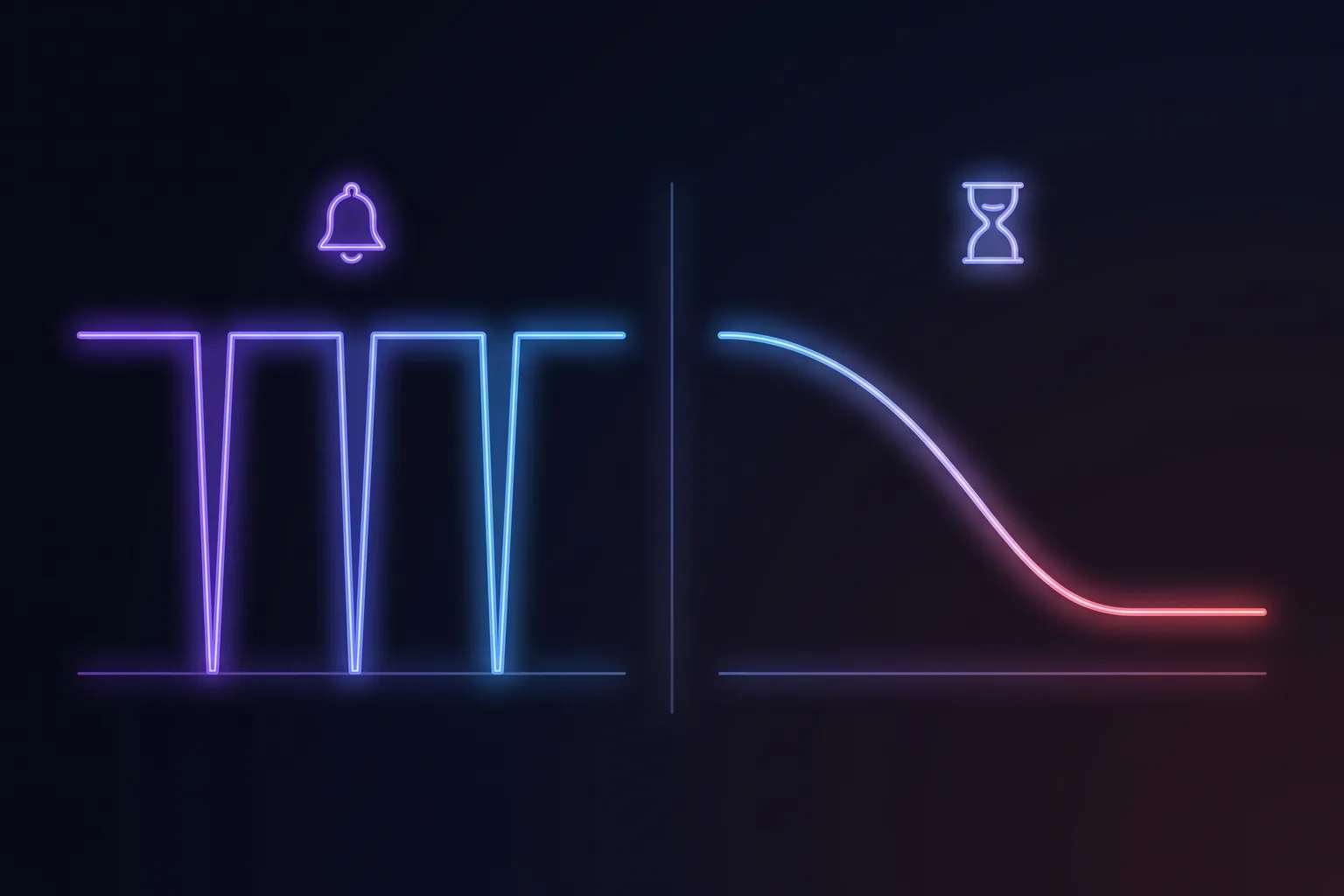
There is a quick self-test. Take a proper ten-minute break, away from every screen, and come back. If the material suddenly makes sense again, you were tired, and your session design is the problem. If you sit back down and immediately reach for your phone, or find yourself three tabs deep, you were being interrupted, and your environment is the problem. Most long study evenings are both, in that order: interruption early, fatigue late.
What the research on breaks and studying actually shows#
This subject is unusually full of confident numbers with nothing under them. The 90 minutes of concentration figure, repeated on half the pages in this SERP, comes from sleep research about ultradian cycles and was never a measurement of studying. So here is what does exist, with its size stated honestly.
The largest relevant study is Danish. Sievertsen, Gino and Piovesan, published in PNAS in 2016, analysed 2 034 964 test results from 570 376 schoolchildren and asked what the time of day did to their scores. Every hour later in the day cost 0.9% of a standard deviation (95% CI 0.7 to 1.0). And a break of 20 to 30 minutes before the test raised the score by 1.7% of a standard deviation (95% CI 1.2 to 2.2).
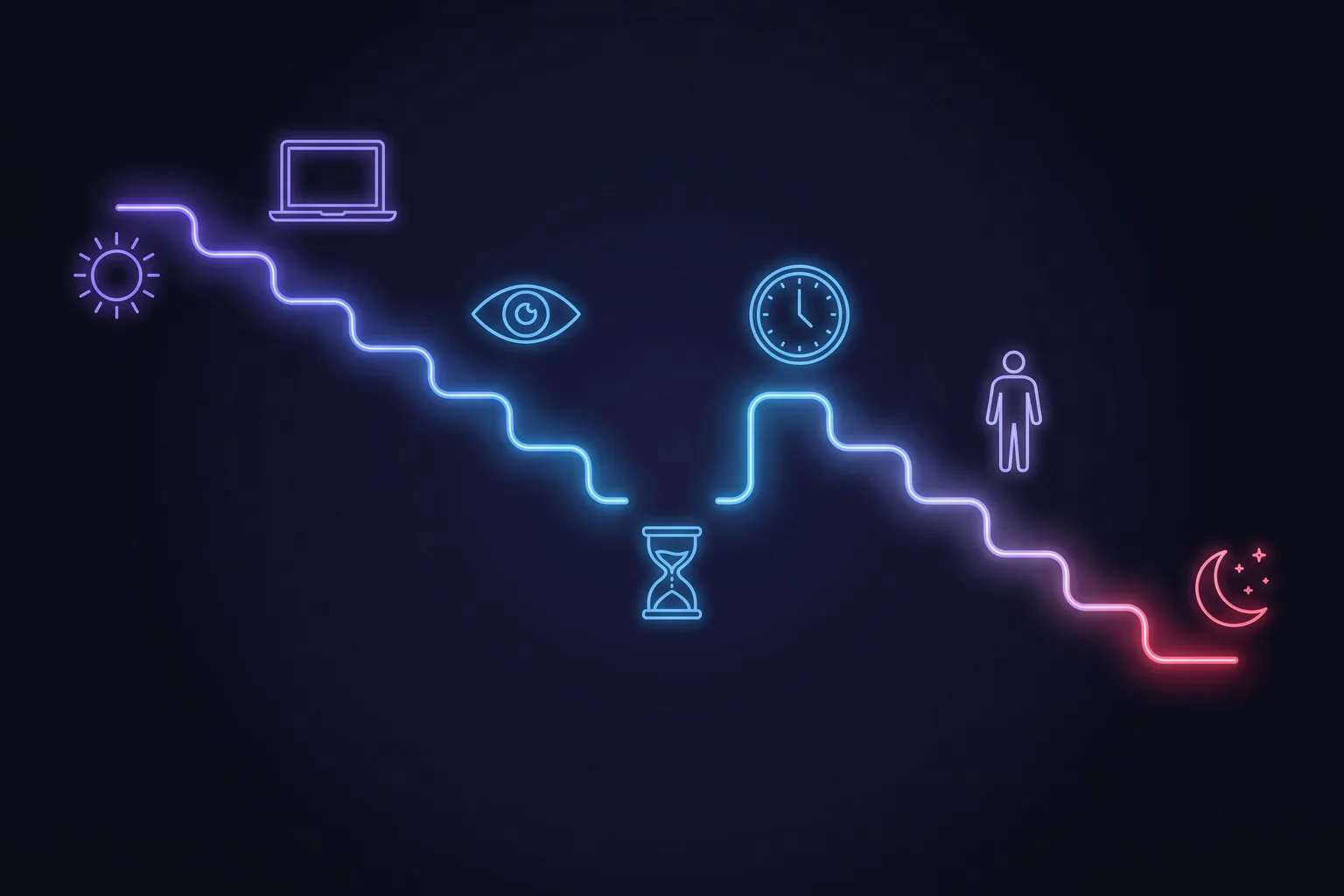
Read that second number carefully, because the honest reading is the useful one: 1.7% of a standard deviation is small. It is not a new brain. What it is worth is roughly two hours of the decline it takes back, which is a fair description of what a break buys you: not a boost, a refund. Anyone promising you more than that from a rest break is selling something.
The mechanism underneath has been shown directly. Ariga and Lleras put people on a long vigilance task and watched performance collapse over time, then showed that brief diversions restored it. Their interpretation is the one that matters for studying: the goal itself deactivates with prolonged use, and briefly leaving it reactivates it. Staring harder is the one thing that does not.
What the evidence does not support is any particular ratio. In 2025, Smits, Wenzel and de Bruin ran 94 university students through two-hour study sessions under Pomodoro, Flowtime and simply breaking when they felt like it, and found no significant winner on productivity, task completion or flow. Pick a rhythm you will keep. The full comparison of the numbers has its own page.
How to focus on studying: the seven things that change a session#
Ordered by how much they move, not by how good they sound. The first four are about interruption, the last three about fatigue, which is the split the usual lists never make.
1. Decide what finished looks like before you sit down
Study for two hours is not a task, it is a duration, and attention does not attach to durations. Finish the exercises up to question 12 is a task. It gives your attention something to return to after every wobble, and it gives the session an end that is not the clock. This is also what makes a break safe to take: you can leave a task and come back to it, whereas leaving a duration just feels like quitting.
2. Handle the phone for the right reason
Silence it and put it out of arm's reach, but do it because a buzzing phone genuinely interrupts you, not because its mere presence drains your mind. That second claim, from a famous 2017 experiment, did not survive a pre-registered replication and shrinks to almost nothing when the studies are pooled. We took the trouble to go through that evidence properly here. The practical version is simple: notifications off, screen down, another room if the room exists, and no guilt about the phone being nearby if it is silent.
3. Make the study screen the only screen
The tab you left open is a stronger interruption than the phone, because it is inside the machine you are working in and requires nothing more than a glance to enter. Close everything not needed for this task, take the browser full screen, and if the material is a PDF or a video, open it in its own space so returning to it is one gesture rather than a hunt. On a shared laptop, a second user account for studying does more than any extension.
4. Put the hardest thing earliest
The Danish data says the same hour is worth less later in the day, and every student knows the version of that from experience: the problem set at 10 pm takes twice as long as it would have at 10 am. Spend your best hours on the material that fights back, and leave copying out, formatting and re-reading for the end, when your attention is worth less anyway.
5. Work in stretches you will actually finish
Somewhere between 25 and 50 minutes, then a break. Shorter for dense material where starting is the hard part, longer for reading and essays where an early break costs you the thread. What matters is not the number: it is that the stretch is short enough that you believe in it when you sit down. A 90-minute block you abandon at 20 minutes has taught you that your plans do not hold, which is expensive.
6. Make the break a real break
This is where most study rhythms fail, and it is the difference between the break in the research and the break you actually take. Scrolling a feed for ten minutes is not a break for your attention: it is the same posture, the same distance, the same medium and a harder stream of information. Stand up. Look out of a window at something far away. Get water. The break has to be a change of activity, not a change of tab, or it does not do the thing the Danish schoolchildren got.
7. Put the end of the stretch outside your own head
The moment a break is due is the exact moment you least want it, and the state that makes studying productive, absorption, is also the state in which you stop noticing time. Deciding in advance to break at half past is a plan made by a rested person for a tired one, and the tired one gets to vote. Something outside you has to call it: a timer, a housemate, an app, a kettle. Which one hardly matters, as long as it is not you at hour three.
How to stay focused while studying for a long session#
A three-hour evening is a different animal from a 45-minute revision block, and it needs a few things the short session does not.
- A real break every two to three hours, 20 to 30 minutes, with food and daylight if there is any left. This is the break size the Danish study measured, and the one people skip first.
- A declared end. Open-ended sessions drift: you stay at the desk long after the useful part finished, which teaches you that studying is endless and makes starting harder tomorrow. Decide when the evening ends before it starts.
- Rotation between kinds of work. Reading, then problems, then writing out notes. Different tasks recruit attention differently, so switching material is partial rest in a way that switching tabs is not.
- A written parking list. Every intrusive thought (an email to send, a thing to google) goes on a piece of paper and is not acted on until the break. This costs three seconds and removes the most common excuse for opening a browser.
- Water and food before, not during. Hunger is a genuine attention tax and a genuine excuse generator.
The part nobody tells you: studying on a screen has a physical half#
Here is what the study-tips genre leaves out entirely. When you read on a screen, your blink rate falls from a relaxed 15 to 20 per minute to as few as 5 to 7, and the blinks that remain are often incomplete. Your tear film thins, your focusing muscles hold one distance for hours, and the result has a clinical name: asthenopia, ordinary eye strain. The American Optometric Association lists its symptoms as blurred vision, dry eyes, headaches and neck and shoulder pain.
Now read that symptom list as a student rather than as a patient. Blurred vision and a headache at hour three do not announce themselves as eye strain. They announce themselves as I have read this paragraph three times and I am clearly not disciplined enough. A large part of the late-evening collapse people attribute to weak willpower is a tired visual system, and it is the half of the problem that no amount of motivation touches.
- Look far away, regularly. Every 20 minutes, at something about 20 feet off, for 20 seconds. That is the whole of the 20-20-20 rule, and it is the cheapest thing on this page.
- Blink deliberately when you notice dryness: ten full, slow closes. Half-blinks do not resurface the tear film.
- Make the text bigger than feels necessary. Small type at a fixed distance is the single most reliable way to earn a headache from a PDF.
- Match the screen to the room. A bright screen in a dark bedroom is a spotlight; the room should be lit enough that the screen is not the brightest thing in it.
- Raise the laptop for a long evening, and use a separate keyboard. A MacBook screen sits below eye level, which is fine for an hour and expensive for five. The neck pain arrives a day later.
How to focus while studying on a Mac, and where macOS stops#
If you study on a MacBook, the machine gives you most of what you need against interruption and almost nothing against fatigue. Worth knowing which is which before you install anything.
- Focus modes (System Settings, then Focus) silence notifications and can switch themselves on to a schedule, so a 7 pm to 10 pm study Focus is genuinely useful. Add the apps and people allowed through, and let it turn itself on: a rule you have to remember to apply is not a rule.
- Screen Time app limits (System Settings, then Screen Time) are the closest built-in thing to enforcement, and their weakness is deliberate: when a limit fires, the sheet offers to ignore it for a minute or for the day. On the evening it matters, you will click it.
- Safari's Distraction Control and Reader strip a page down to its text. For reading a long article or a paper, Reader removes the sidebars, the video that autoplays and half the reasons you were about to leave the page.
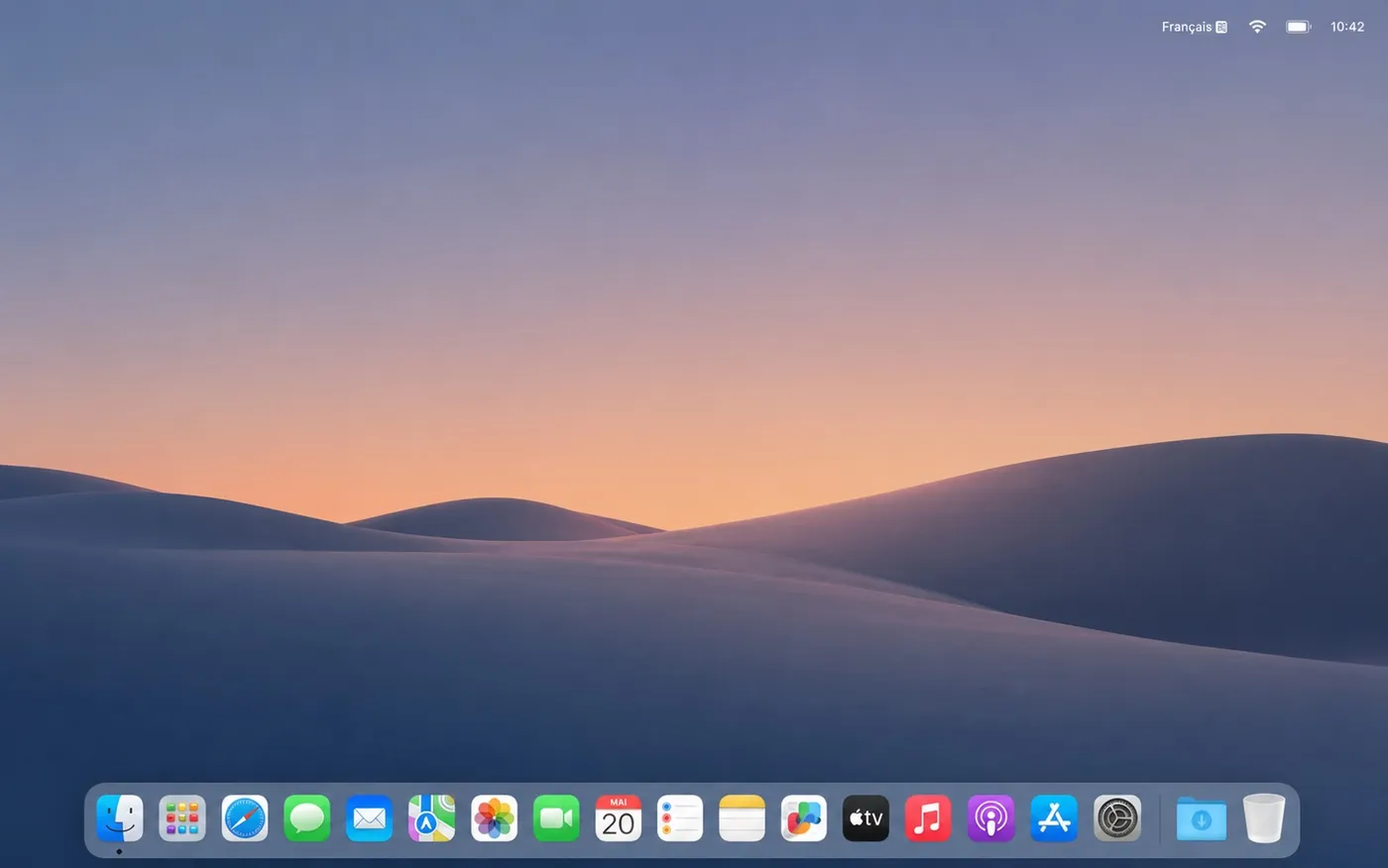
- Hide the Dock (System Settings, Desktop and Dock, automatically hide) and work full screen. The Dock is a permanent row of invitations, and the red badges on it are designed to be seen from the corner of your eye.
- Night Shift and True Tone shift the colour temperature in the evening. Useful for sleep, irrelevant to concentration. Do not let a warmer screen persuade you that you have addressed session length.
Notice the pattern: every built-in tool is good at protecting a study block and none of them is willing to end one. Ending it is the unpopular half, which is exactly why it gets left to the person least able to do it at that moment.
When this stops being a focus problem#
Concentration is a study-skills question right up until it is not. A few patterns are not solved by a better rhythm, and are worth taking to a doctor, an optometrist, a campus health service or a student counselling service rather than to another article like this one.
- You cannot concentrate for even short blocks, for weeks, across every subject, including the ones you enjoy, and it predates exam season. Persistent attention difficulty deserves a proper assessment rather than a better timer, and if that describes your whole working life rather than your revision, the ADHD and burnout piece covers what that assessment involves.
- Headaches, blurred vision or eye pain that do not clear overnight or when you stop studying. Symptoms that track your screen day and fade by morning are ordinary eye strain; symptoms that persist regardless of rest need an eye exam, and an uncorrected prescription is one of the most common reasons studying feels unbearable.
- Sleep that has stopped working. Weeks of lying awake after study sessions, or waking unrefreshed, will undo more retention than any technique on this page can win back.
- Low mood, no interest in things you used to like, and a sense of being ineffective, together and lasting. That combination is not a concentration problem, and it is treatable.
- Studying feels impossible rather than hard, or you are relying on stimulants that are not yours to get through sessions. Both are worth saying out loud to someone qualified.
None of that is an emergency in most cases, and none of it is a character failure. It is just the point where the useful question stops being how to concentrate and starts being what is actually going on.
Frequently asked questions
Why can't I focus while studying?
How can I improve concentration and focus while studying?
How to focus when studying at home?
How do I focus on homework when I don't want to do it?
How long should a study session be before I lose focus?
Do breaks actually improve studying, or do they just feel good?
Does putting my phone in another room really help me focus?
Sources & further reading
- Sievertsen, Gino & Piovesan, Cognitive fatigue influences students' performance on standardized tests, PNAS 113(10):2621-2624 (2016)
- University of Illinois / ScienceDaily: Brief diversions vastly improve focus, researchers find (Ariga & Lleras, 2011)
- Smits, Wenzel & de Bruin, Investigating the effectiveness of self-regulated, Pomodoro, and Flowtime break-taking techniques among students, Behavioral Sciences 15(7):861 (2025)
- Ruiz Pardo & Minda, Reexamining the brain drain effect: a replication of Ward et al. (2017), Acta Psychologica (2022)
- American Optometric Association: Computer vision syndrome
- Albulescu et al., Give me a break! A systematic review and meta-analysis on the efficacy of micro-breaks, PLOS ONE (2022)