Written by Alex Ren
Updated on 17 min read
Carpal tunnel from typing: what the symptoms actually mean, and the two conditions mistaken for it
Quick summary Hands that go numb at night, fingers that tingle by mid-afternoon, a grip that drops a mug for no reason: the internet has one answer for all of it, and the answer is carpal tunnel from too much typing. Two things are worth knowing before you accept that. Carpal tunnel symptoms have a very specific signature, precise enough that you can often tell in ten seconds whether yours fit. And the research linking it to keyboards is far weaker than the ergonomics industry lets on. Here is what the symptoms actually point to, what commonly gets mistaken for carpal tunnel, and what genuinely helps.
In this article
- What carpal tunnel syndrome actually is
- What does carpal tunnel feel like?
- Does typing actually cause carpal tunnel syndrome?
- The two conditions most often mistaken for carpal tunnel syndrome
- What actually helps, in the order worth trying it
- Why the break is the part that actually sticks
- When to stop self-treating and get it looked at
- Frequently asked questions
This is general information rather than medical advice, and hand symptoms are one of the areas where an in-person exam earns its money. But most people searching at 2 am with a numb hand want the same two things first: to know whether this pattern is the classic one, and to know what to do tonight. That is what the next few sections are for.
What carpal tunnel syndrome actually is#
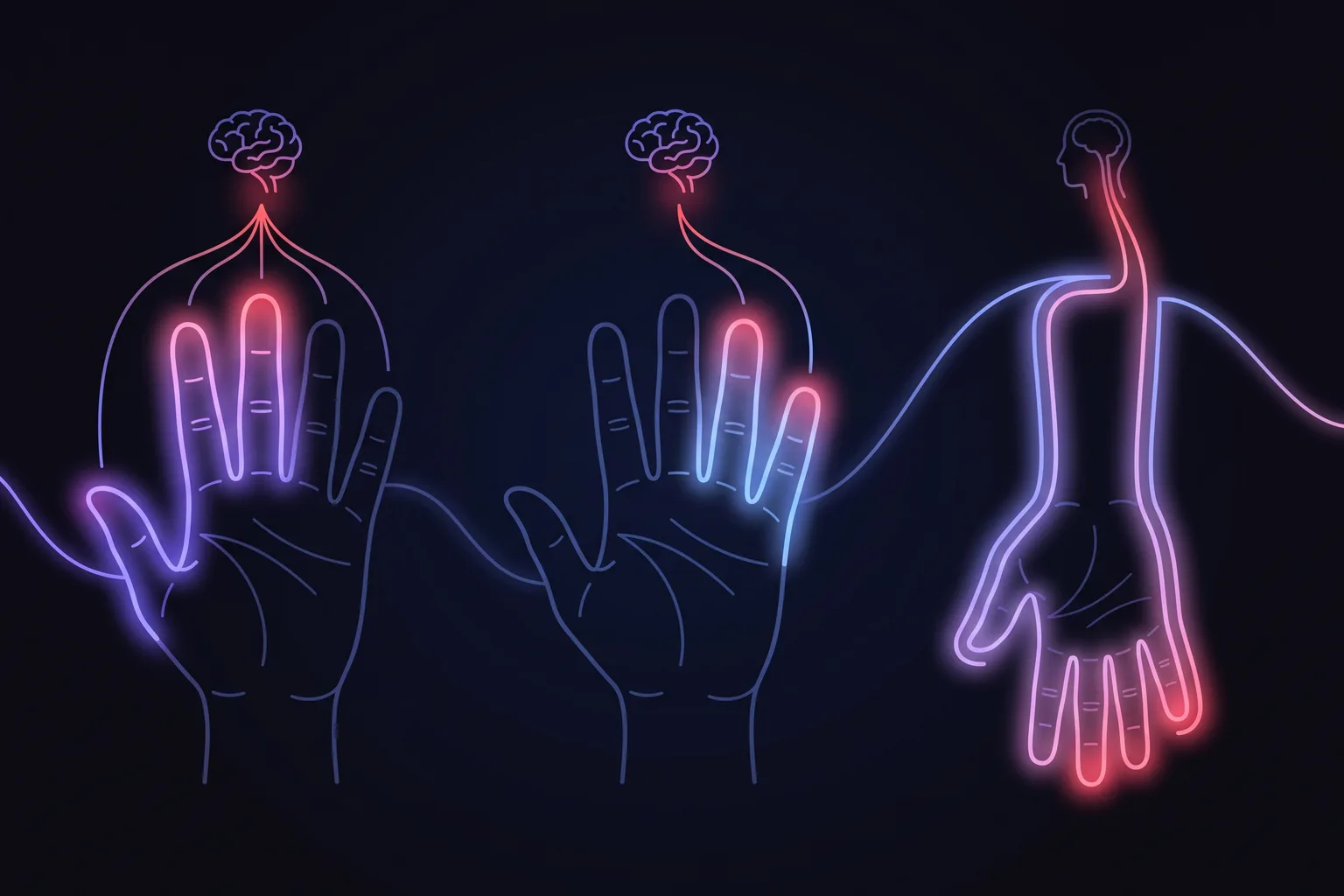
The carpal tunnel is a narrow passage on the palm side of your wrist, roughly an inch across, floored by the wrist bones and roofed by a tough band of ligament. Nine tendons and one nerve pass through it. Carpal tunnel syndrome is what happens when the pressure inside that tunnel rises far enough, or for long enough, to squeeze the nerve: the median nerve. That single anatomical fact produces the most useful clue you have, because the median nerve serves a defined patch of hand and no more. As the American Academy of Orthopaedic Surgeons describes it, it carries sensation from the thumb, index finger, middle finger and the thumb side of the ring finger. The little finger is not part of the deal, and neither is the outer half of the ring finger.
That split down the middle of the ring finger is the tell almost nobody knows about. Numbness in the little finger is not carpal tunnel. Numbness across the whole hand and up the forearm is usually not carpal tunnel either. Numbness in the thumb, index and middle fingers, worst at night, very often is.
What does carpal tunnel feel like?#
The classic description is not really pain. It is numbness, tingling and a burning quality, often with a hand that feels swollen and clumsy without looking swollen at all. The NHS notes that these symptoms usually start slowly, come and go at first, and are typically worse at night. The signs that a clinician would recognise immediately:
- It wakes you up. Night symptoms are the single most characteristic feature. In one review of referred patients, 84% of people with carpal tunnel syndrome had night-time paresthesia. We sleep with our wrists curled, which raises pressure in the tunnel.
- You shake your hand to make it stop, and it works. This flick of the wrist in the middle of the night is so common that hand surgeons have a name for it.
- It hits the right fingers: thumb, index, middle, and the thumb half of the ring finger. Not the little finger.
- Fine work gets clumsy. Buttons, keys, earrings, picking up coins. You drop things not because your arm is weak, but because your thumb has stopped reporting accurately.
- It comes and goes early on, flaring after a long drive, a book held for an hour, a night on your side, before it starts becoming constant.
| What you feel | Usual suspect | The tell | First move |
|---|---|---|---|
| Numb thumb, index, middle finger, worst at night | Carpal tunnel syndrome | Shaking the hand relieves it | Neutral wrist splint at night |
| Tingling little finger and ring finger | Cubital tunnel (ulnar nerve at the elbow) | Worse with the elbow bent or leaning on a desk | Stop resting on your elbow, keep it straighter |
| Pain from the neck, down the arm, into the hand | Cervical radiculopathy | Changes when you turn or tip your head | Treat the neck, not the wrist |
| Sharp pain on the thumb side of the wrist | De Quervain's tenosynovitis | Worst gripping, lifting, wringing a cloth | Reduce pinch grip and thumb load |
| Diffuse ache in forearm and hand after long sessions | Muscle fatigue and tendon load | Fades overnight and on days off | Vary the load, break the static holding |
Does typing actually cause carpal tunnel syndrome?#
Here is where the popular story and the evidence part company. A systematic review of computer mouse and keyboard use and carpal tunnel syndrome went through the epidemiological studies and found all of them limited, several of them showing risks below one (that is, computer users faring no worse), and pressure measurements inside the carpal tunnel during ordinary computer work sitting below the levels considered harmful. Its conclusion is blunt: the evidence does not support a causal relationship between computer work and carpal tunnel syndrome.
The risk factors that do have weight behind them are mostly not about your keyboard. The NHS and the AAOS both list heredity (some people simply have a smaller tunnel), pregnancy, diabetes, thyroid disease, rheumatoid arthritis, obesity, previous wrist fractures, and work that combines high force, awkward wrist angles and vibration, the profile of a packing line or a chainsaw rather than a laptop.
None of which means your hands are imagining things. Two claims are easy to confuse: "typing causes carpal tunnel syndrome" is poorly supported, while "long static computer work causes hand, forearm, shoulder and neck complaints" is not seriously in doubt. What a desk day reliably produces is sustained low-level load with almost no variation: wrists held slightly extended for hours, a hand shaped around a mouse, an elbow parked on an armrest, forearm muscles never fully switching off. That produces aching, fatigue and irritated tendons, and it can absolutely make a genuine nerve problem feel worse. It is also the part you can actually change.
The two conditions most often mistaken for carpal tunnel syndrome#
If you only remember two alternatives, make them these: cervical radiculopathy (a nerve pinched in the neck) and cubital tunnel syndrome (the ulnar nerve compressed at the elbow). Both produce numbness and tingling in a hand, both are common in people who sit at desks, and both get treated as carpal tunnel for months before someone checks. A 2025 review in Diagnostics found that among patients referred with hand symptoms, carpal tunnel alone accounted for 20% of cases, cervical radiculopathy for 47%, and both at once for 26%, which is a striking distribution if you assumed the wrist was the default answer.
Cervical radiculopathy: the hand symptom that starts in the neck
When a nerve root is irritated where it leaves the spine, the symptom is felt far downstream, in the arm and hand. The distinguishing features are the ones above the shoulder: neck pain or stiffness (present in around three quarters of cases in that review), symptoms that change when you turn your head, tip it back or hold it in one position, and pain that travels in a stripe down the arm rather than sitting in the hand. Night symptoms are less dominant than in carpal tunnel. If your hand trouble arrived in the same season as a stiff, aching neck from desk work, start there.
Cubital tunnel syndrome: the elbow one, and desk workers give it to themselves
The ulnar nerve runs behind the inside of your elbow through a shallow groove, which is the funny bone. Compress it there and you get numbness and tingling in the little finger and the outer half of the ring finger: the exact fingers carpal tunnel spares. It is worse when the elbow is bent for a long time (a phone held to the ear, sleeping with arms curled) and worse with pressure on the elbow, which is what happens when you lean on a desk edge or an armrest all day. If your little finger is the numb one, the wrist splint you just bought is aimed at the wrong joint.
One more worth naming, because it is common in people who type and grip a mouse all day: de Quervain's tenosynovitis, an irritation of the tendons on the thumb side of the wrist. That one is pain rather than numbness, sharpest when you grip, lift or twist, and it often follows a period of heavy thumb use.
What actually helps, in the order worth trying it#
Assuming your symptoms fit the carpal tunnel pattern and are mild to moderate (they come and go, nothing is constantly numb, no muscle has visibly shrunk), the first-line measures are cheap, undramatic and well established.
- Wear a wrist splint at night. This is the highest value thing on the list, and the least intuitive, because the treatment happens while you sleep rather than while you work. A carpal tunnel brace holds the wrist straight so it cannot curl into the position that raises pressure in the tunnel, and the NHS suggests giving it up to six weeks before judging it. Buy the version that keeps the wrist neutral, not the elastic wrap that just feels supportive, and wear it every night rather than on bad nights only.
- Change what your hands do during the day, not just how they sit. Keep wrists roughly level rather than cocked back, bring the mouse close instead of reaching, stop resting the underside of your wrist hard on the desk edge while typing, and stop leaning on your elbows (which is the cubital tunnel favour you can do yourself in one minute).
- Break up the static holding. The problem with a desk day is not any single position, it is eight hours of the same one. This is where breaks earn their place, and it is the one lever that also helps the neck, shoulders and eyes at the same time.
- Try hand exercises, with realistic expectations. Tendon and nerve gliding exercises are standard in hand therapy and the AAOS lists them among nonsurgical options. The NHS is honest that the evidence for hand exercises is limited. They are free, they take a minute, and they are worth trying, but they are not the part doing the heavy lifting.
- Treat the neck if the neck is involved, because a quarter of referred patients have both problems at once, and fixing only the wrist leaves half the symptom in place.
- Get the underlying causes looked at. Diabetes, thyroid problems, rheumatoid arthritis and pregnancy all change the picture, and the first three change the treatment.
Carpal tunnel exercises and stretches worth a minute
These are the ones commonly given in hand therapy. Do them slowly, a few times each, several times a day, and stop if any of them increases the numbness rather than easing it. Stretching into pain is not a technique, it is just pain.
- Tendon glide: start with fingers straight, then move through four shapes, hook fist, full fist, tabletop, straight fingers, pausing a couple of seconds in each. This slides the tendons through the tunnel rather than loading them.
- Median nerve glide: arm out to the side, palm up, wrist gently extended, then tip your head away from that hand until you feel a light pull, and release. Gentle is the whole instruction here: a nerve glide should never be a stretch you brace against.
- Wrist extensor stretch: arm straight out, palm down, use the other hand to bend the wrist down until you feel it along the top of the forearm. Hold 20 to 30 seconds. This one targets the forearm fatigue that a keyboard genuinely does cause.
- Prayer stretch: palms together in front of your chest, lower the hands towards your waist while keeping the palms flat, hold 20 to 30 seconds.
- Open and shake: simply opening the hands wide, spreading the fingers, and shaking them out for a few seconds every so often, which is the least scientific and most reliably done item on the list.

Why the break is the part that actually sticks#
Every list like the one above has the same weakness: it assumes you will remember. You will not, because deep work is precisely the state in which you stop noticing your body, and hand fatigue creeps rather than announces itself. The good news is that the intervention with evidence behind it is also the simplest. In an Applied Ergonomics study of computer terminal work, microbreaks reduced discomfort in every body region measured, with the best results at 20-minute intervals, and no negative effect on productivity. Short and frequent beats long and occasional, which is the same conclusion we reached comparing break schedules like 52/17 and the Pomodoro technique.
That is the exact gap Pausr was built to close, and I built it because I kept losing the same argument with myself. It runs a short break every 20 minutes and a longer stand-up break less often, announces each one a few seconds ahead so you can finish your sentence, and holds the break automatically when you are in a meeting, sharing your screen or gaming, so it never fires at the worst possible moment. A 20-second break is enough to open your hands, drop your shoulders and look out of the window: the whole trick is that it happens 20 times a day without you deciding anything. It is macOS-only, entirely local, and needs no account.


When to stop self-treating and get it looked at#
Carpal tunnel syndrome is one of the conditions where waiting has a real cost, because prolonged compression can leave permanent nerve damage and muscle loss. Book an appointment rather than another gadget if:
- The numbness has become constant rather than coming and going. Intermittent is early, constant is not.
- The muscle at the base of your thumb looks flatter than on the other hand, or your grip and pinch have measurably weakened. Visible wasting is a reason to be seen quickly.
- Six weeks of night splinting has changed nothing, which is the point the NHS suggests going back to a GP.
- Symptoms started after a fall or a wrist injury, or came with swelling, redness or heat.
- Your neck is clearly involved, with pain radiating down the arm, weakness, or symptoms that change with head position.
- You have diabetes, thyroid disease or rheumatoid arthritis, or you are pregnant, all of which change both the cause and the plan.
The reassuring part: most mild and moderate cases improve with splinting, load changes and time, and pregnancy-related cases often resolve after birth. The treatments beyond that (a steroid injection, and release surgery when nonsurgical measures fail) are well trodden, and the surgery has a good track record. What you want to avoid is the middle path of doing nothing for a year while quietly losing thumb strength.
Frequently asked questions
What does carpal tunnel feel like?
What are the first signs of carpal tunnel syndrome?
Can typing give you carpal tunnel syndrome?
What two conditions are often misdiagnosed as carpal tunnel syndrome?
Should I wear a carpal tunnel brace at night or during the day?
Do carpal tunnel exercises and stretches actually work?
How do I know if my hand symptoms are coming from my neck?
When should I see a doctor about carpal tunnel symptoms?
Sources & further reading
- NHS: Carpal tunnel syndrome
- OrthoInfo (American Academy of Orthopaedic Surgeons): Carpal Tunnel Syndrome
- OrthoInfo (American Academy of Orthopaedic Surgeons): Ulnar Nerve Entrapment at the Elbow (Cubital Tunnel Syndrome)
- Thomsen et al., Carpal tunnel syndrome and the use of computer mouse and keyboard: a systematic review, BMC Musculoskeletal Disorders (2008)
- Diagnostic Dilemmas in Carpal Tunnel Syndrome and Cervical Spine Disorders: A Comprehensive Review, Diagnostics (2025)
- McLean et al., Computer terminal work and the benefit of microbreaks, Applied Ergonomics (2001)
- CDC / NIOSH: Ergonomics and musculoskeletal disorders
- OSHA: Computer workstations eTool