Written by Alex Ren
Updated on 21 min read
ADHD burnout: the cycle everyone draws, the deficit everyone skips, and what actually helps
Quick summary ADHD burnout is the exhaustion that builds when you spend years working harder than everyone around you to produce the same ordinary day. It is a real experience with a real cost, and it is also not a diagnosis: no manual defines it, and the five-stage cycle that every article on this subject draws has never been studied. That gap matters, because it is the reason most of the advice you will read is generic. Here is what the research does support, the one deficit it is genuinely sure about, what helps at work, and when to stop reading and get seen.
In this article
- What is ADHD burnout?
- The ADHD burnout cycle, and why no one has measured it
- How it differs from ordinary burnout, and from autistic burnout
- The one deficit the research is genuinely sure about: time
- How to focus with ADHD when you are already depleted
- What actually has evidence behind it at work
- Why remote work and a Mac make this harder than it needs to be
- When to stop reading articles and get seen
- Frequently asked questions
This is general information rather than medical advice, and it is written for people who work at a screen all day, which is the population I know. A bias to declare up front: I build a break app, so I have an obvious interest in telling you that breaks matter. They do, narrowly, and they are not the first item on the list below. The order is the useful part.
What is ADHD burnout?#
ADHD burnout is the state of exhaustion, loss of function and flatness that arrives after a long stretch of compensating for ADHD symptoms. The compensation is the part that distinguishes it. Someone without ADHD who burns out has usually been carrying too much work. Someone with ADHD has often been carrying an ordinary amount of work plus the invisible second job of making an ADHD brain produce neurotypical output: the reminders on top of reminders, the rehearsed small talk, the deadlines survived by all-nighters, the constant self-monitoring for the thing you were about to forget. That second job has no end date, which is why the tiredness does not clear the way ordinary tiredness does.
Now the part almost nobody writes down. ADHD burnout is not a clinical diagnosis, and it has no agreed definition. It appears in neither the DSM-5-TR nor the ICD-11. Even plain occupational burnout, which is far better established, is classified by the World Health Organization as an occupational phenomenon rather than a medical condition. ADHD burnout sits a step further out than that: it is a description that the ADHD community developed, that clinicians recognise in their consulting rooms, and that the research literature has barely touched.
The ADHD burnout cycle, and why no one has measured it#
Search this subject and you will meet the same diagram three or four times: a five-stage cycle running from hyperfocus and overcommitment, through symptoms breaking through, into overwhelm, then shutdown, then guilt, then back to the beginning. It is drawn with the confidence of a finding. It is not one. No study has defined those stages, tested whether people move through them in that order, or checked whether the cycle predicts anything at all. It is a useful picture that spread because it is recognisable, and being recognisable is not the same as being measured.
I am not saying the pattern is imaginary. Plenty of people with ADHD read that cycle and recognise their last two years in it, and that recognition is worth something. I am saying you should know which parts of this subject rest on evidence and which parts rest on a widely shared description, because the difference changes what you should do next. Advice built on the cycle tends to be generic: rest, be kind to yourself, set boundaries. Advice built on what is actually established points somewhere much more specific, and we will get there in two sections.
How it differs from ordinary burnout, and from autistic burnout#
The comparison that makes the evidence gap concrete is autistic burnout, because that one did get studied. In 2020, researchers published a formal characterisation of autistic burnout built from interviews with autistic adults and analysis of community writing, defining it as chronic exhaustion, loss of skills and reduced tolerance to stimulus. It took a phenomenon the community had described for years and turned it into something with a definition researchers can now test against. ADHD burnout has not had its equivalent. Same kind of lived experience, same community origin, one has been through the process and one has not.
| Occupational burnout | ADHD burnout | Autistic burnout | |
|---|---|---|---|
| Formal status | ICD-11 occupational phenomenon, not a disease | No definition in any manual | No manual entry, but a published research definition |
| What drives it | Chronic workplace conditions left unmanaged | Years of compensating for symptoms, on top of the work itself | Life-long masking and sensory or social load |
| Signature feature | Cynicism about the job, reduced professional efficacy | Executive function collapsing first: the systems stop working | Loss of skills you previously had, lower tolerance to stimulus |
| Does time off fix it | Not if you return to the same conditions | Rarely, because the compensation resumes on day one back | Not on its own, and reduced demands matter more than rest |
| Where to start | Change something structural in the work | Reduce what needs compensating for, then treat the ADHD | Reduce load and demands, formally where possible |
The row that changes behaviour is the last one. If you treat ADHD burnout as ordinary burnout, you take a holiday and come back to the same brain doing the same compensating, and the clock restarts on the first morning. If you treat it as an ADHD problem, the question becomes which parts of the compensating you can hand to something outside your head, and that is a question with concrete answers.
The one deficit the research is genuinely sure about: time#
Here is where the evidence gets solid, and it is the part the SERP skips entirely. A meta-analysis pooling 55 studies found that people with ADHD are measurably worse at perceiving time, across every way researchers know how to test it: telling two intervals apart, estimating how long something took, reproducing a duration they have just experienced. The effects were medium and they held across the lifespan, in adults as well as children. This is not a self-report finding or a community description. It is a laboratory-measured deficit, replicated dozens of times.
Read that alongside the standard burnout advice and the contradiction jumps out. Every article tells you to take regular breaks, protect your evenings and notice when you have been going too long. All of that advice assumes an internal clock that ADHD demonstrably does not supply. Telling someone with a measured time-perception deficit to notice the time is like telling someone short-sighted to look harder. It is not a motivation problem and it is not a discipline problem: the sense the instruction depends on is the one that is impaired.
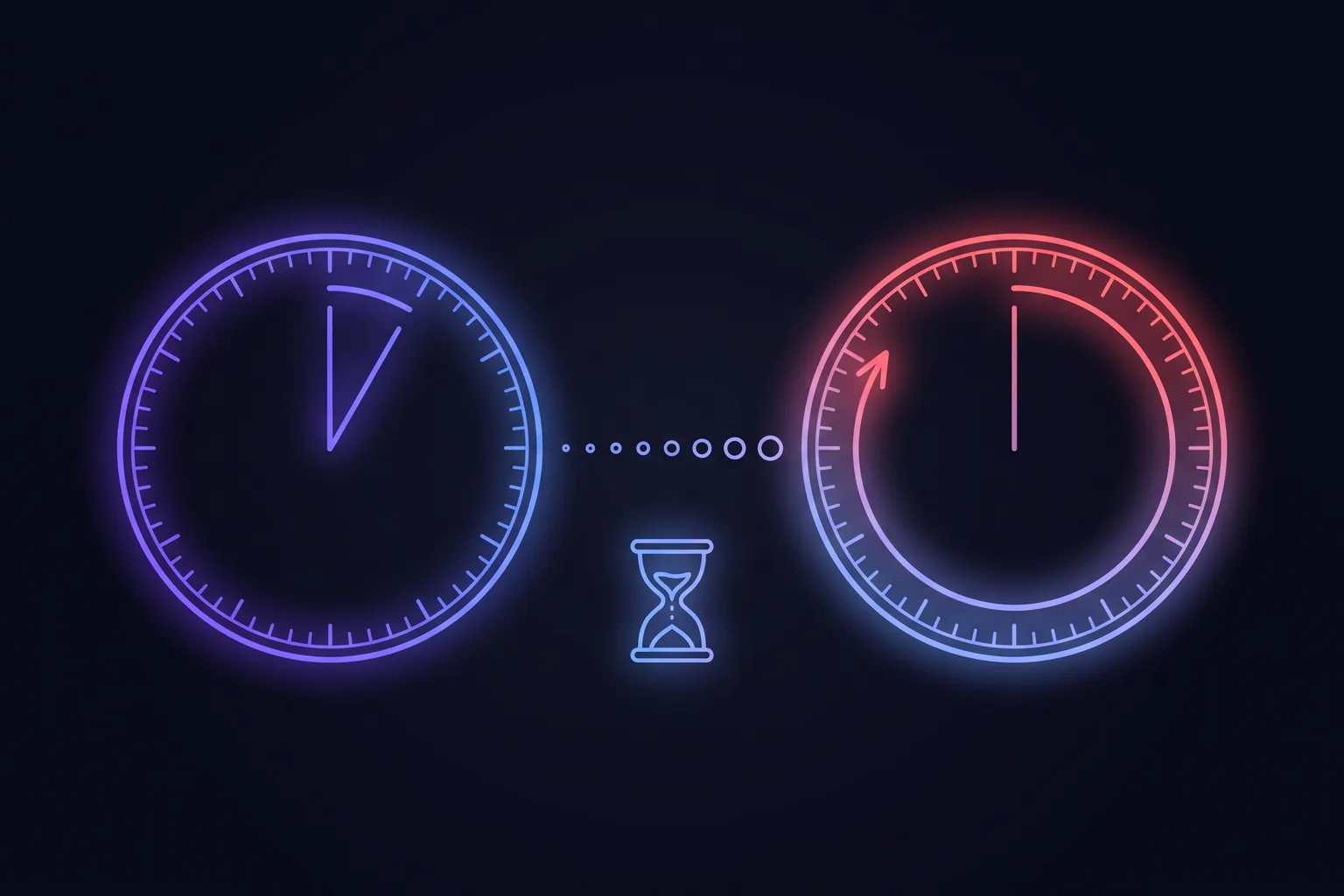
This is also the mechanism behind the two experiences people with ADHD describe most often at work. Hyperfocus, where four hours vanish and you surface stiff, hungry and behind on everything you did not do. And its mirror, where a fifteen-minute task has somehow eaten the afternoon. Neither is a moral failure. Both are what happens when the clock you are steering by does not run true.
How to focus with ADHD when you are already depleted#
Focus advice written for the general population assumes a baseline you do not have on a bad month, so most of it fails at exactly the moment you need it. What follows is ordered by how much load it takes off you, not by how impressive it sounds.
- Externalise time before anything else. A timer that runs on its own beats any intention to check the clock, because checking the clock is the thing that does not happen. This is the single highest-return change available and it is nearly effortless to set up.
- Make the next action absurdly small. Executive function is what collapses first in ADHD burnout, and starting is the executive step that costs the most. Two minutes of the task, or opening the file and nothing else, gets past the part that is actually broken.
- Use body doubling. Working alongside someone, in person or on a silent video call, is one of the most reliable strategies ADHD adults report, and it costs nothing to try. The literature on it is thin, so I offer it as widely reported rather than as proven.
- Cut decisions, not just distractions. A tidy desk helps less than a day where the order of work was decided last night. Every decision at the start of a task is a tax on the resource that is depleted.
- Stop treating sleep as negotiable, because everything above works better rested, and none of it works at all on five hours. Sleep problems and ADHD travel together, and this is the one lever that improves every other item on the list.
- Move. Physical activity has real evidence behind it for ADHD symptoms, and a walk is also the one break that reliably ends, unlike a phone.
Does the Pomodoro technique work for ADHD?
It is the most recommended technique in every ADHD forum, so it deserves a straight answer: no randomised trial has ever tested the Pomodoro technique in people with ADHD. Anyone telling you it is proven for ADHD is telling you something nobody has measured. What can be said honestly is narrower and still useful. The technique's active ingredient is that it replaces an internal sense of elapsed time with an external one, and an externally cued interval is precisely the compensation that a measured time-perception deficit calls for. The mechanism lines up. The trial does not exist.
In practice, two modifications come up again and again from people with ADHD who make it stick. The classic 25 minutes is often wrong in both directions: too short to be worth entering a task for on a good day, too long to face on a bad one, so treat the number as a dial rather than a rule. And the break has to actually interrupt you, which a self-managed timer you can dismiss will not do, because dismissing it is free and hyperfocus makes the decision for you. If you want the comparison between interval lengths in full, we wrote that up separately.
How to focus with ADHD without medication
First, the thing that would be dishonest to leave out: for ADHD, medication is the best-evidenced treatment there is, by a distance, according to a network meta-analysis covering children, adolescents and adults. Nothing in this section is a substitute for that, and if you are undiagnosed, an assessment is a better use of the next month than any technique on this page. This section is for the situations that are genuinely common: you are waiting on an assessment, you are between doses, medication is not available to you, you cannot tolerate it, or you have chosen not to take it.
In that case, the strategies that carry the most weight are the environmental ones rather than the motivational ones. Externalise time, as above. Externalise memory too, into one capture place you trust rather than four you half-use. Reduce the number of live decisions in a day. Protect sleep and move your body. And, where the work is the problem, ask for accommodations rather than absorbing the gap yourself: the Job Accommodation Network keeps a free, concrete list of workplace adjustments for ADHD, from flexible scheduling to written instructions to uninterrupted blocks, and most of them cost an employer nothing.


That is the narrow slot Pausr fills, and I want to be exact about how narrow it is. A break app does not treat ADHD, does not replace an assessment, and cannot fix a job that is structurally too much. What it removes is one specific failure: the gap between intending to take breaks and actually taking them, which for an ADHD brain is not a willpower gap but a time-perception one. Pausr runs a short break every 20 minutes and a longer stand-up break less often, announces each a few seconds ahead so it does not yank you out of a thought, and holds the break automatically during meetings, screen shares and games instead of interrupting them. It keeps an honest count of your screen time with no streaks and no scolding when you skip one, which matters more than it sounds when you are already running on empty and do not need one more thing measuring you. It is macOS-only, entirely local, and needs no account.
What actually has evidence behind it at work#
If you only take one item from this article into a conversation with your manager or your clinician, take this one rather than anything about timers. A randomised controlled trial of 46 adults with ADHD tested Work-MAP, a metacognitive intervention delivered by occupational therapists over eleven weekly sessions, and found significant improvements in work performance, executive function and quality of life, still holding three months later. That is a proper trial, on adults, about work specifically. It is also the kind of help almost nobody searching this subject is told exists, because it does not fit in a listicle.
Two other things belong ahead of any productivity system. Treating the ADHD itself, since the compensating is what exhausts you and less to compensate for is the only change that addresses the cause. And formal accommodations, which move part of the load off you and onto the job's design, where it belongs. In the UK, NICE's ADHD guideline covers adult diagnosis and management and is worth quoting at a reluctant employer or GP; in the US, ADHD can qualify as a disability for workplace accommodation purposes, which is the framing the Job Accommodation Network above is built around.
Where do breaks sit in that order? Below all of it, honestly. The best evidence for short breaks is a meta-analysis of 22 studies finding micro-breaks reduce fatigue and increase vigour, and that work was done in general populations, not in ADHD. I am extending a general finding to a specific group on the strength of a mechanism, which is a reasonable thing to do and is not the same as proof. Breaks are what stops an ordinary hard week from compounding. They are not a treatment.
Why remote work and a Mac make this harder than it needs to be#
Remote work removed the external structure that used to do this job for free. The commute was an ending nobody designed and everyone used. The office emptied at a certain hour and you left with it. Colleagues walking past your desk were, without anyone calling it that, a stream of involuntary time cues arriving all day. Take all of that away from someone whose internal clock is measurably unreliable, and there is nothing left marking the passage of the afternoon except the work itself, which never signals that it is finished.
The machine can give some of that structure back, and macOS in particular has more of it than most people use.
- Focus modes are the wrong default for this. A Focus mode that silences everything also silences the cues telling you time is passing. If you use one for deep work, make sure whatever is supposed to interrupt you is on its allowed list, or you have built a room with no clock in it.
- Screen Time reports what already happened, not what is happening. It is useful on a Sunday for noticing a pattern, and useless at four in the afternoon on Wednesday, which is when you actually needed the information.
- Set the clock to show seconds and the date. A menu bar clock that moves is a weak cue, but a free one, and weak beats absent. System Settings, Control Centre, then Clock.
- Calendar events with a real alert are the cheapest external timer you already own, including one that just says stand up.
- Put the laptop somewhere with an end. If the machine lives on the kitchen table, the working day has no edge at all, and no software fixes a room.
None of that is exotic, and that is rather the point. The reason this section exists is that the entire first page of results for ADHD burnout discusses rest, self-care and therapy without once mentioning the device where the exhausting work actually happens.
When to stop reading articles and get seen#
Exhaustion has a long list of causes, several of which are treatable and none of which you can rule out from a blog. See a doctor rather than trying another system if any of the following is true.
- You suspect you have ADHD and have never been assessed. This is the single highest-value appointment available to you, and everything else on this page works better after it. In the UK, the NHS ADHD pages explain the route; in the US, the NIMH overview is a sound starting point.
- Low mood, loss of interest or hopelessness has arrived with the tiredness. Burnout and depression overlap heavily and are told apart by a professional, not by a table on a website. This one is not a wait-and-see.
- The exhaustion no longer tracks your working week, and is there at weekends, on holiday and around people you enjoy.
- Sleep has broken down for weeks, or you snore heavily and wake unrefreshed, which is worth checking for sleep apnoea rather than filing under stress.
- You are already treated for ADHD and something has changed: medication that used to work no longer does, or the side effects have become the problem. That is a prescriber conversation, not a dosage experiment.
- Alcohol or anything else has become how you get through the evening. Substance use and untreated ADHD travel together often enough that it is worth naming out loud.
If you ever have thoughts of harming yourself, that is not something to manage alone or to research further: contact your local emergency services or a crisis line straight away. In the UK that is 999, or 111 for urgent but non-emergency help. In the US, call or text 988. Anywhere in the European Union, 112 reaches the emergency services. If you are somewhere else, look up your own country's crisis line now rather than waiting until you need it.
Frequently asked questions
What is ADHD burnout?
Is the ADHD burnout cycle real?
How is ADHD burnout different from regular burnout?
How is ADHD burnout different from autistic burnout?
Does the Pomodoro technique work for ADHD?
How do you focus with ADHD without medication?
How long does ADHD burnout last?
Can breaks prevent ADHD burnout?
Why is ADHD burnout worse when working from home?
Sources & further reading
- Marx, Cortese, Koelch and Hacker, Meta-analysis: Altered Perceptual Timing Abilities in Attention-Deficit/Hyperactivity Disorder, Journal of the American Academy of Child and Adolescent Psychiatry (2022)
- Raymaker et al., Having All of Your Internal Resources Exhausted Beyond Measure and Being Left with No Clean-Up Crew: Defining Autistic Burnout, Autism in Adulthood (2020)
- Grinblat and Rosenblum, Work-MAP Telehealth Metacognitive Work-Performance Intervention for Adults With ADHD: Randomized Controlled Trial, OTJR (2023)
- Cortese et al., Comparative efficacy and tolerability of medications for ADHD in children, adolescents and adults: a systematic review and network meta-analysis, The Lancet Psychiatry (2018)
- World Health Organization: Burn-out an occupational phenomenon, International Classification of Diseases (ICD-11)
- NICE guideline NG87: Attention deficit hyperactivity disorder, diagnosis and management
- National Institute of Mental Health: Attention-Deficit/Hyperactivity Disorder
- NHS: Attention deficit hyperactivity disorder (ADHD)
- Job Accommodation Network: workplace accommodations for ADHD
- Albulescu et al., Give me a break! A systematic review and meta-analysis on the efficacy of micro-breaks for increasing well-being and performance, PLOS ONE (2022)