Written by Alex Ren
Updated on 8 min read
52/17 vs Pomodoro vs 90-minute deep work blocks: which break schedule fits you?
Quick summary Short answer: there is no universally best work-break rhythm. Pomodoro (25 minutes on, 5 off) suits fragmented days and hard-to-start tasks. The 52/17 rule matches sustained but interruptible knowledge work. Ninety-minute blocks fit deep, creative work that takes twenty minutes just to load into your head. The honest move is matching the schedule to your work, not forcing your work into someone else's schedule.
All three methods answer the same underlying fact: focus is not a flat line. Attention degrades over sustained effort, and brief recovery restores it. Where the methods differ is the cadence, and the cadence turns out to matter a lot depending on what kind of work you do. Here is where each number actually comes from, because two of the three are less scientific than their fans believe.
The three methods, and where their numbers come from#
Pomodoro Technique: 25/5, born from a kitchen timer
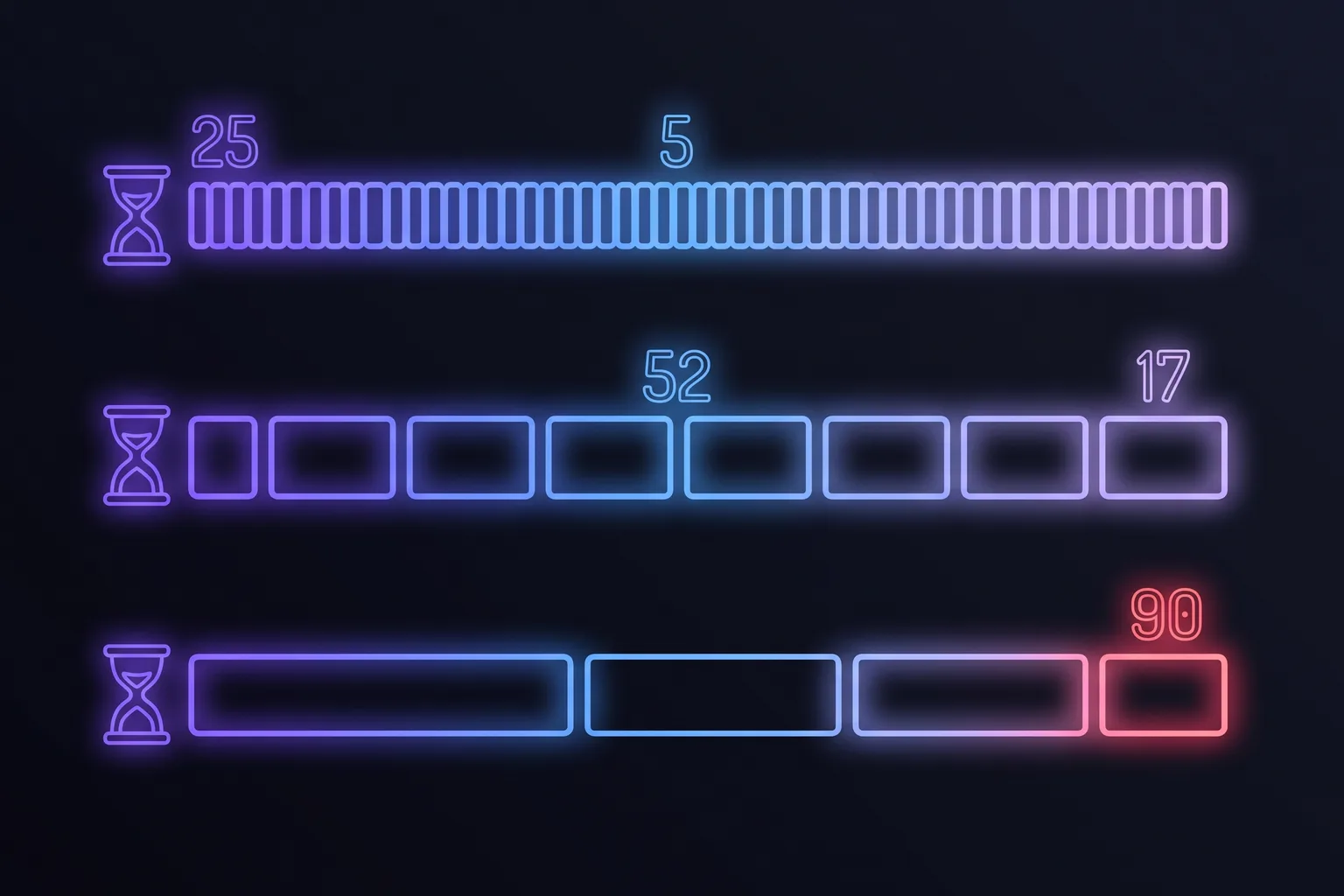
The Pomodoro Technique was invented by Francesco Cirillo in the late 1980s, named after the tomato-shaped kitchen timer he used as a student. The prescription: 25 minutes of single-task focus, 5 minutes off, and a longer break after four cycles. Its origin is personal experimentation, not research, and that is fine: its real strength is psychological. Twenty-five minutes is short enough to start when you do not feel like starting. That makes Pomodoro less a productivity schedule than an anti-procrastination device, and as one, it is excellent.
The 52/17 rule: what the most productive 10% actually did
The 52/17 rule comes from data rather than doctrine: in 2014, the time-tracking company DeskTime analyzed its most productive users and found the top 10% tended to work in stretches of about 52 minutes followed by roughly 17 minutes fully away from the computer. Two caveats worth stating plainly: it is an observational pattern from one company's user base, not a controlled trial, and the magic is probably not the exact numbers. What the finding really says is that the most productive people worked with full intensity, then genuinely disengaged, instead of half-working for ten hours. Fifty-two minutes is also long enough to do real work, which is where Pomodoro frustrates many people.
90-minute blocks: riding the ultradian rhythm
The 90-minute school leans on sleep researcher Nathaniel Kleitman's basic rest-activity cycle: the observation that human alertness oscillates in roughly 90-minute cycles, at night and, more loosely, during the day. The famous supporting data point is Ericsson's study of elite violinists, who practiced in sessions of about 90 minutes separated by real rest. The evidence that daytime ultradian cycles should dictate your calendar is thinner than the productivity literature implies, but the practical observation survives: hard creative work has a loading cost, often 15 to 20 minutes before you are fully inside a problem. A schedule that interrupts you every 25 minutes never amortizes that cost.

| Pomodoro (25/5) | 52/17 rule | 90-minute blocks | |
|---|---|---|---|
| Origin | Francesco Cirillo, personal method (1980s) | DeskTime productivity data (2014) | Ultradian rhythm research, elite-performer practice |
| Evidence type | Anecdotal, huge adoption | Observational data | Sleep science extrapolated to daytime |
| Best for | Procrastination, fragmented days, admin and email | Sustained knowledge work, mixed days | Deep, creative, high-loading-cost work |
| Break style | 5 min, frequent | 17 min, real disengagement | 20 to 30 min, full recovery |
| Weak spot | Shatters flow just as it starts | Awkward fit with meeting-driven calendars | Hard to protect 90 clean minutes; punishing if interrupted |
| Daily cycles realistic | 8 to 12 | 5 to 7 | 2 to 4 |
What the science agrees on, whatever the cadence#
Strip away the branding and the research converges on three points. First, attention genuinely degrades over sustained work: Ariga and Lleras showed that even brief diversions restore performance on long vigilance tasks. Second, breaks recover more than they cost: a 2022 meta-analysis of 22 studies found micro-breaks reliably increase vigor and reduce fatigue. Third, disengagement quality beats break length: 17 minutes away from every screen restores more than 17 minutes scrolling a feed at the same desk. The scroll break is a break for your task list, not for your attention. And whichever cadence you choose, your eyes, your body and your attention each keep their own clock: how often each one needs a break is its own guide.
Which break schedule fits your workstyle?#
The wrong question is "which method is best". The right one is "what does my typical day look like". A few honest mappings:
- Your calendar is meeting-driven (30 and 60 minute slots everywhere): forget rigid cycles; work in the gaps and protect the breaks between calls. Pomodoro-length focus slices fit the cracks best.
- You do sustained but interruptible work (code reviews, writing, support, analysis): 52/17 is your natural rhythm. One real disengaged break per hour, roughly.
- You do deep creative work with a high loading cost (architecture, research, design, long-form writing): 90-minute blocks, two or three per day, with real recovery between them. Guard them like meetings with yourself.
- You struggle to start at all: Pomodoro, unapologetically. Momentum first, optimization later.
- Your days alternate between modes: mix them. A morning 90-minute block, 52/17 through the afternoon, a Pomodoro to survive the post-lunch dip. No method police will come.
This mapping is exactly how Pausr approaches it: instead of imposing one doctrine, its onboarding builds a Workstyle Profile and offers presets like Sprint 45 and Deep Work 90 alongside the classic short cadence, then layers eye breaks and stand-up breaks on top, whichever rhythm you choose. Breaks hold automatically during meetings and calls, so the schedule bends to your day instead of shattering against it. And because there are no streaks, switching rhythms mid-week costs you nothing.
One last honest note: whichever cadence you pick, the failure mode is identical to the 20-20-20 rule's. Deep in focus, you will not notice the 52nd minute any more than the 20th. The schedule only exists if something enforces it. Choose your rhythm, then delegate the clock-watching to a tool built for exactly that, a timer, anything that is not the person doing the focusing.

21
Completed
- Eye break
- Standing break
- Long break
Frequently asked questions
What is the 52/17 rule?
Is 52/17 better than the Pomodoro Technique?
How long should a work break be?
What is ultradian rhythm work?
How many 90-minute deep work blocks can you do per day?
What should I do during the breaks?
Which break schedule does Pausr use?
Sources & further reading
- DeskTime: The 52/17 ratio of the most productive people
- The Muse: The Rule of 52 and 17: It's Random, But it Ups Your Productivity
- The Pomodoro Technique, official site (Francesco Cirillo)
- Wikipedia: Basic rest-activity cycle (Nathaniel Kleitman)
- Ericsson, Krampe & Tesch-Römer, The role of deliberate practice in the acquisition of expert performance, Psychological Review (1993)
- University of Illinois / ScienceDaily: Brief diversions vastly improve focus, researchers find (Ariga & Lleras, 2011)
- Albulescu et al., Give me a break! A systematic review and meta-analysis on the efficacy of micro-breaks, PLOS ONE (2022)
- American Psychological Association: Give me a break, the research on rest at work