Written by Alex Ren
Updated on 9 min read
The 20-20-20 rule: what science actually says about eye strain and blue light, and how to actually stick to it
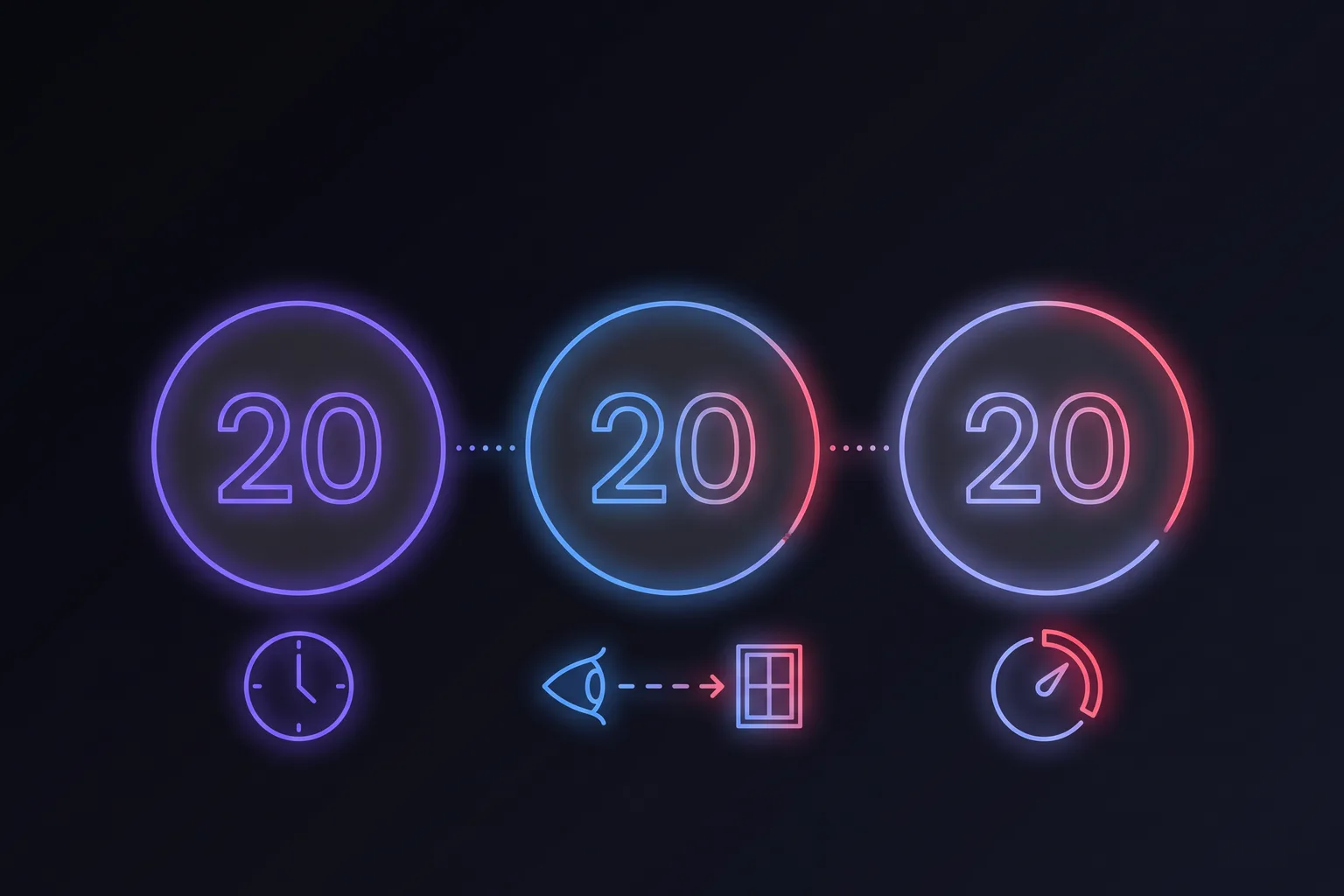
Quick summary The 20-20-20 rule says: every 20 minutes of screen work, look at something 20 feet (about 6 meters) away for at least 20 seconds. It is the single most repeated piece of advice against digital eye strain, endorsed by the American Academy of Ophthalmology and the American Optometric Association. Here is what the evidence actually supports, where the rule is oversold, what blue light has to do with any of it, and why knowing the rule has almost nothing to do with following it.
In this article
- The problem it solves: screen eye strain is real and very common
- What the evidence actually says about the 20-20-20 rule (the honest version)
- How to reduce blue light exposure (and what it actually changes)
- Why almost nobody sticks to the 20-20-20 rule
- How to actually stick to the 20-20-20 rule
- Frequently asked questions
The rule was popularized by Californian optometrist Jeffrey Anshel as a simple, memorable prescription for patients who spent their days at a computer. Its logic is mechanical: your eyes converge and your focusing muscles (the ciliary muscles) stay contracted at near distance, and your blink rate collapses while you concentrate. Looking far away relaxes the focusing system; twenty seconds is roughly the time it takes to do so; and blinking normally again rewets the surface of the eye.
The problem it solves: screen eye strain is real and very common#
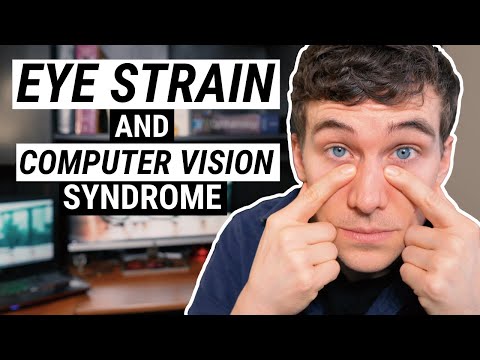
Digital eye strain (dry eyes, blurred vision, headaches, sore neck and shoulders) is not a niche complaint. A 2023 meta-analysis in Scientific Reports pooled studies across tens of thousands of participants and found that roughly two out of three screen users report symptoms of computer vision syndrome, with higher rates in heavy users. The American Optometric Association lists prolonged near focus and reduced blinking as core mechanisms.
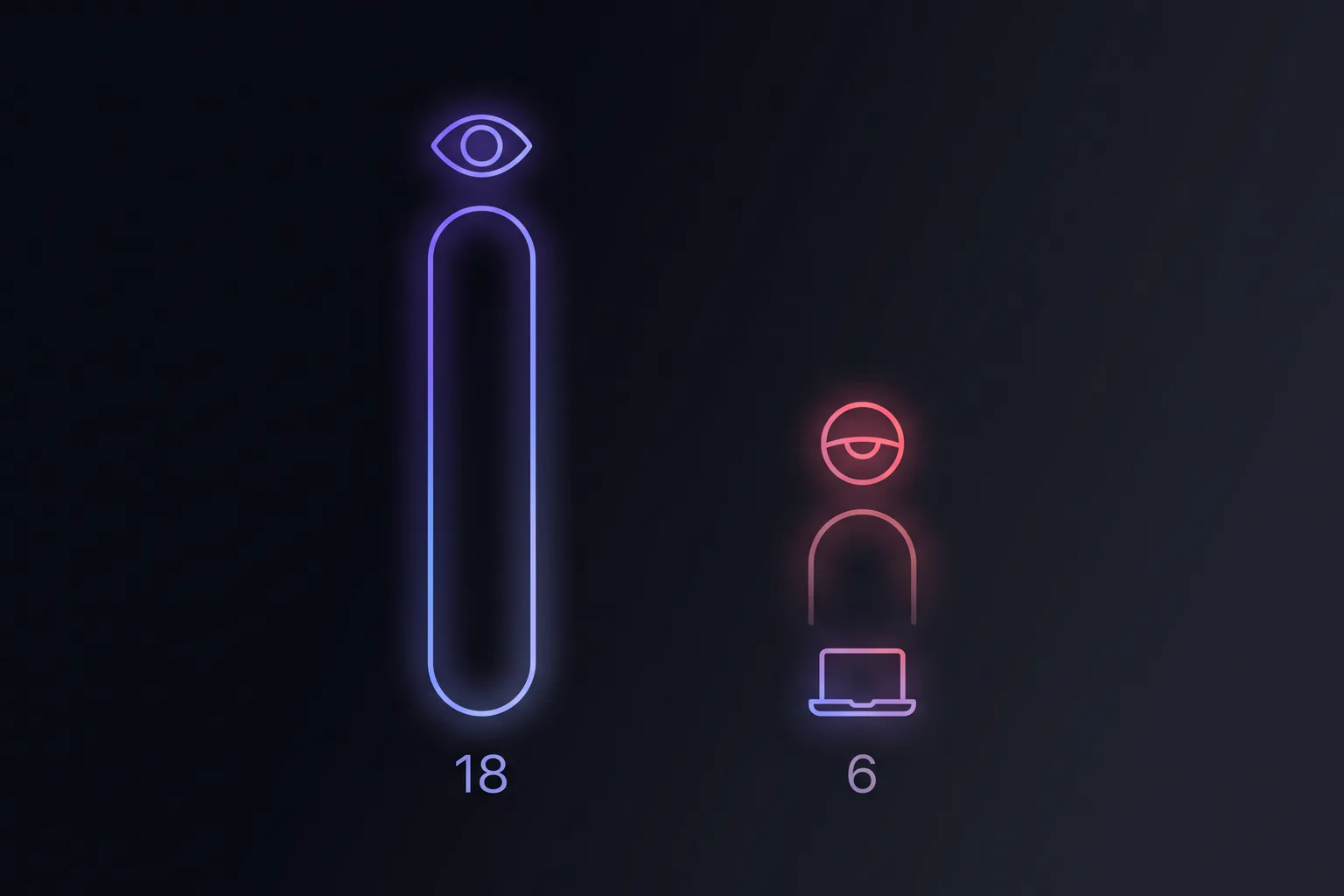
The blinking part deserves its own sentence: at a screen, your blink rate can drop from a relaxed 15 to 20 blinks per minute to as few as 5 to 7, and many of the remaining blinks are incomplete. Less blinking means a drier, more irritated eye surface by late afternoon. If your eyes burn at 6 pm, this is most of the reason. Remote workers get an extra dose of all of it, because working from home adds two to three hours of daily screen time.
What the evidence actually says about the 20-20-20 rule (the honest version)#
Here is the part most articles skip: the specific numbers 20-20-20 are a memorable prescription, not a precisely validated dose. The American Academy of Ophthalmology recommends the rule as sensible practice, but researchers who have gone looking for direct trials of those exact numbers have found surprisingly few. A 2023 study of university students found that students who practiced 20-20-20-style habits reported fewer asthenopic (eye strain) symptoms, and also found that the overwhelming majority did not practice it consistently.
So the fair summary is: regular distance breaks demonstrably help with symptoms; whether the magic interval is 20 minutes or 25, and the magic duration 20 seconds or 40, matters far less than whether the break happens at all. The rule earns its place the same way "drink eight glasses of water" does: not because eight is sacred, but because a number you remember beats a nuance you forget.
| Symptom | Mechanism | Does 20-20-20 help? |
|---|---|---|
| Dry, burning eyes | Blink rate collapses during screen focus | Yes: breaks restore blinking and rewet the eye |
| Blurred vision late in the day | Ciliary (focusing) muscle fatigue at near distance | Yes: distance viewing relaxes the focusing system |
| Headaches around the eyes | Sustained near focus and convergence effort | Often: less accumulated strain over the day |
| Neck and shoulder pain | Posture held frozen for long stretches | Partially: standing breaks help more than eye breaks |
| Poor sleep after evening screen use | Blue light exposure and arousal before bed | No: cutting evening light exposure is the fix there |
How to reduce blue light exposure (and what it actually changes)#
Blue light gets blamed for everything a screen does to you, so it is worth being precise. The American Academy of Ophthalmology points out that the blue light coming off a monitor is a small fraction of what you already get from daylight, and that it is not what makes your eyes ache at 6 pm: reduced blinking and hours of near focus are. A 2023 Cochrane review of blue-light-filtering lenses found no meaningful benefit for eye strain either, which is why the glasses question gets its own honest answer in our guide to reducing eye strain instead of a shopping link here.
Where blue light genuinely matters is timing, not eye comfort: bright light late in the evening delays your body clock and costs you sleep. So the useful way to reduce blue light exposure is not a purchase, it is a schedule. Dim the screen and the room in the last hour or two before bed, let night mode warm the display after sunset, keep the phone off the pillow, and get real daylight into your eyes in the morning, which is the exposure that does the most for your body clock and the one most screen workers are short of. During the working day, though, less blue light will not settle your eyes. Breaking the near focus will, which is exactly what the next 20 seconds of the 20-20-20 rule are for.
Why almost nobody sticks to the 20-20-20 rule#
Knowing the rule is genuinely useless on its own, and the adherence data proves it. In the student study above, most participants knew about protective habits and a small minority applied them consistently. The reason is not laziness. It is that the rule asks the impossible: it asks the person deepest in concentration to spontaneously notice that 20 minutes have passed. Deep focus is precisely the state in which you do not notice time. The rule self-destructs on contact with the situation it was designed for.
This is why "I'll just remember" fails, why a sticky note on the monitor fails after day three, and why the fix has to be external. You do not remember to blink more; something has to interrupt you, briefly and at the right moment.
How to actually stick to the 20-20-20 rule#
- Make the reminder automatic. A break reminder app fires every 20 minutes so you do not have to notice the clock. This is the single highest-leverage change; everything else is decoration.
- Make the reminder context-aware. A reminder that interrupts your client call gets disabled within a week, and then you are back to nothing. Choose a tool that holds the break during meetings and screen sharing.
- Look out a window, not at a wall. Twenty feet is a minimum, not a target. A window gives your eyes real distance and gives the habit a small reward.
- Blink deliberately a few times at the start of each break. It sounds absurd; it rewets the eye surface faster than waiting for reflex blinking to recover.
- Pair it with movement once an hour. The 20-second eye break fixes your eyes, not your spine. Standing up every 45 to 60 minutes covers the rest of the sitting problem.
For what it is worth, this exact failure mode is why Pausr exists. It takes the remembering out of the rule entirely: the 20-second eye break arrives every 20 minutes on its own, with a short warning first so it never cuts a sentence in half. When you are on a call, presenting or mid-game, the break quietly waits its turn, and your daily count sits in the stats. Skipping one costs nothing, because what matters is the break after it, not a scoreboard. Users who need only that habit and nothing else also have solid alternatives, which we compare honestly in our roundup of break reminder apps.
Next break
12:47
Look away
Coming up
- Stand up31 min
- Step away1 h 14
Frequently asked questions
What is the 20-20-20 rule?
Does the 20-20-20 rule actually work?
Does 20 feet have to be exact?
How can I remember the 20-20-20 rule?
How do I reduce blue light exposure from screens?
Is the 20-20-20 rule enough on its own?
Sources & further reading
- American Academy of Ophthalmology: Computers, Digital Devices and Eye Strain
- American Optometric Association: Computer vision syndrome
- The 20/20/20 rule: practicing pattern and asthenopic symptoms among university students, PMC (2023)
- Prevalence of computer vision syndrome: a systematic review and meta-analysis, Scientific Reports (2023)
- Healthline: How Does the 20-20-20 Rule Prevent Eye Strain?
- Singh et al., Blue-light filtering spectacle lenses for visual performance, macular protection, and sleep quality, Cochrane Database of Systematic Reviews (2023)
- American Optometric Association: Comprehensive eye exams
- National Eye Institute: Keep your eyes healthy